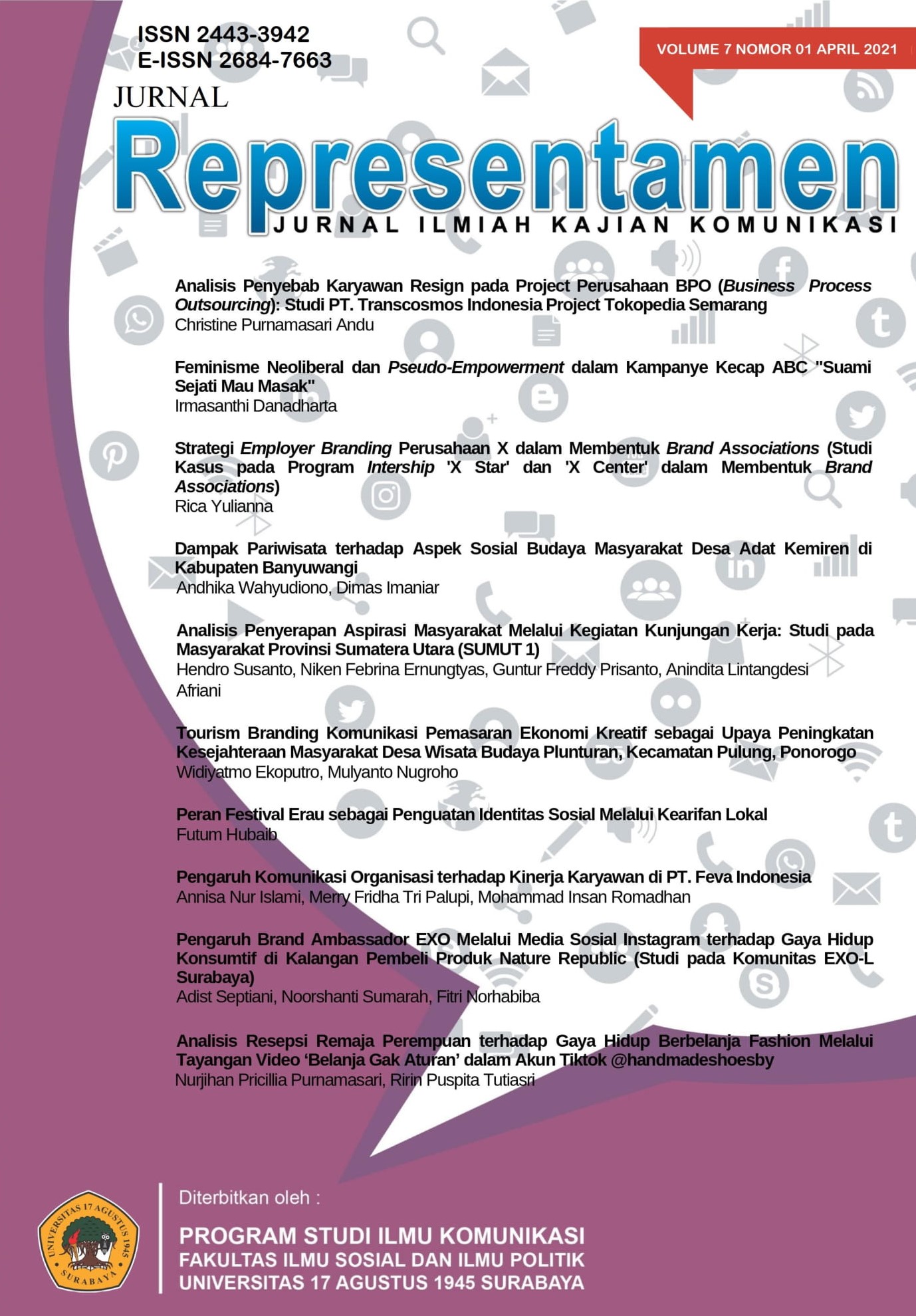
Peran Festival Erau sebagai Penguatan Identitas Sosial Melalui Kearifan Lokal
DOI:
https://doi.org/10.30996/representamen.v7i01.5126Abstract
This study aims to determine the role of the Erau Festival through local wisdom in an effort to strengthen social identity in the new adaptation era. Kutai Kartanegara Regency has a variety of cultures that live side by side, in harmony and peace. There are many ethnic groups who live in Kutai Kartanegara Regency and still carry their culture of origin, including Sumatra, Java, Sulawesi, Kalimantan to Nusa Tenggara. The number of immigrants is increasing over time, it is estimated that someday the number of immigrants will exceed the original population. Although the number of immigrants in Kutai Kartanegara Regency is quite large, their presence does not change the role of local culture that has been deeply rooted in the people of Kutai Kartanegara Regency. This study uses a qualitative approach with descriptive methods. Data obtained through observation, interviews, and documentation. The results showed that: (1) the relevance of local wisdom to strengthening social identity because the value of local wisdom is not an obstacle in the era of globalization, but is a major force in building regional social identity; (2). The erau festival reflects local wisdom.
Keywords: Erau, Kutai Kartanegara, Local Wisdom
Downloads
References
Anderman, L. H., & Anderman, E. M. (1999). Social Predictors of Changes in Students’ Achievement Goal Orientations. Contemporary Educational Psychology, 24(1), 21–37. https://doi.org/10.1006/ceps.1998.0978
Ang, R. P., & Huan, V. S. (2006). Relationship between Academic Stress and Suicidal Ideation: Testing for Depression as a Mediator Using Multiple Regression. Child Psychiatry and Human Development, 37(2), 133–143. https://doi.org/10.1007/s10578-006-0023-8
Biron C, Brun JP, I. H. (2008). Extent and sources of occupational stress in university staff. Work, 30(4). Retrieved from https://www.ncbi.nlm.nih.gov/pubmed/18725713
Buhs, E. S., & Ladd, G. W. (2001). Peer rejection as antecedent of young children’s school adjustment: An examination of mediating processes. Developmental Psychology, 37(4), 550–560. https://doi.org/10.1037/0012-1649.37.4.550
Chernomas, W. M., & Shapiro, C. (2013). Stress, Depression, and Anxiety among Undergraduate Nursing Students. International Journal of Nursing Education Scholarship, 10(1). https://doi.org/10.1515/ijnes-2012-0032
Dada, J. O., Babatunde, S. O., & Adeleye, R. O. (2019). Assessment of academic stress and coping strategies among built environment undergraduate students in Nigerian higher education. Journal of Applied Research in Higher Education, 11(3), 367–378. https://doi.org/https://doi.org/10.1108/JARHE-06-2018-0100
Elias, H., Ping, W. S., & Abdullah, M. C. (2011). Stress and Academic Achievement among Undergraduate Students in Universiti Putra Malaysia. Procedia - Social and Behavioral Sciences, 29, 646–655. https://doi.org/10.1016/j.sbspro.2011.11.288
Goff, A.-M. (2011). Stressors, Academic Performance, and Learned Resourcefulness in Baccalaureate Nursing Students. International Journal of Nursing Education Scholarship, 8(1). https://doi.org/10.2202/1548-923X.2114
Gunawati, R., Hartati, S., & Listiara, A. (2010). Hubungan antara Efektivitas Komunikasi ahasiswa-Dosen Pembimbing Utama Skripsi dengan Stres dalam Menyusun Skripsi pada Mahasiswa Program Studi Psikologi Fakultas Kedokteran Universitas Diponegoro. Jurnal Psikologi, 3(2), 93–115. https://doi.org/https://doi.org/10.14710/jpu.3.2.93-115
Jimenez, C., Navia-Osorio, P. M., & Diaz, C. V. (2010). Stress and health in novice and experienced nursing students. Journal of Advanced Nursing, 66(2), 442–455. https://doi.org/10.1111/j.1365-2648.2009.05183.x
Kariv, D., & Heiman, T. (2005). Task-Oriented Versus Emotion-Oriented Coping Strategies: The Case of College Students. College Students Journal, 39(1), 72–89. Retrieved from https://www.researchgate.net/publication/287831370_Task-oriented_versus_emotion-oriented_coping_strategies_The_case_of_college_students
Kupriyanov, R., & Zhdanov, R. (2014). The Eustress Concept: Problems and Outlooks. World Journal of Medical Sciences, 11(2), 179–185. https://doi.org/10.5829/idosi.wjms.2014.11.2.8433
Moscaritolo, L. M. (2009). Interventional Strategies to Decrease Nursing Student Anxiety in the Clinical Learning Environment. Journal of Nursing Education, 48(1), 17–23. https://doi.org/10.3928/01484834-20090101-08
Downloads
Published
Issue
Section
License
Authors whose manuscript is published will approve the following provisions:
The right to publication of all journal material published on the jurnal representamen website is held by the editorial board with the author's knowledge (moral rights remain the property of the author).
The formal legal provisions for access to digital articles of this electronic journal are subject to the terms of the Creative Commons Attribution-ShareAlike (CC BY-SA) license, which means Jurnal Representamen reserves the right to store, modify the format, administer in database, maintain and publish articles without requesting permission from the Author as long as it keeps the Author's name as the owner of Copyright.
Printed and electronic published manuscripts are open access for educational, research and library purposes. In addition to these objectives, the editorial board shall not be liable for violations of copyright law.