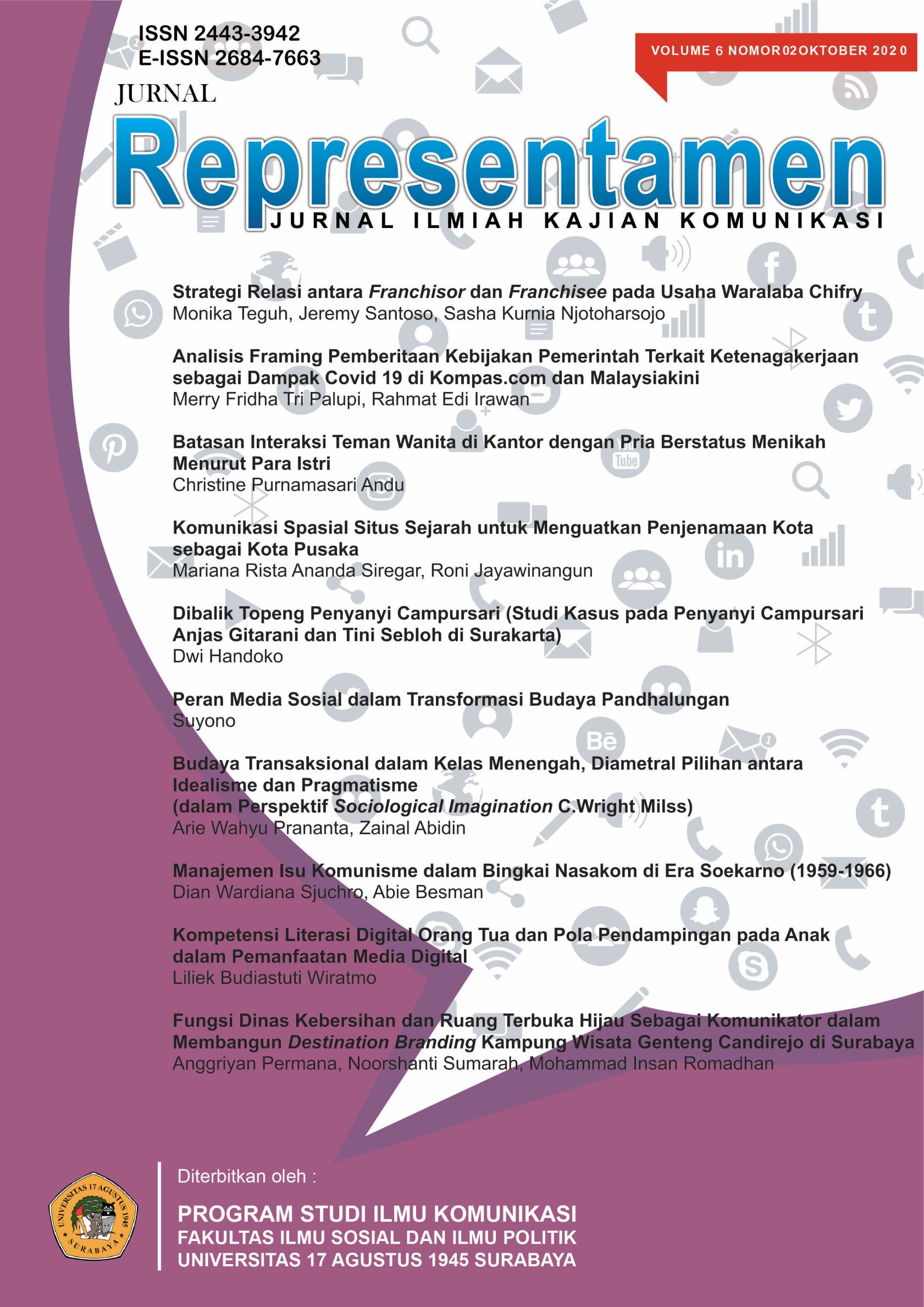
Analisis Framing Pemberitaan Kebijakan Pemerintah Terkait Ketenagakerjaan sebagai Dampak Covid 19 di Kompas.com dan Malaysiakini
DOI:
https://doi.org/10.30996/representamen.v6i02.4262Abstract
Abstract
In the beginning of 2020 the mass media coverage was adorned with information about covid-19 outbreaks. The spread of covid-19 has crossed continents and even the rest of the world, making this period called as pandemic because it has infected 4.9 million people. The magnitude of this incident made the media including Kompas.com and Malaysiakini.com continue to convey information not only about health issues, but also other impacts in various fields such as law, politics, security and other social issues such as the economy and employment. This online news portal from Indonesia and Malaysia always reports on the development of covid-19 outbreaks in their respective countries. So much news was uploaded by the two online media that researcher only chose one news related to labor policy as the impact of covid-19 outbreaks. Using the theory of reality construction from Peter L. Berger, researcher analyzed the news framing using Robert N Enmant's model. The results showed an imbalance between the two online news portals because it only represented one party, where Kompas.com fetched news about wages from the point of view of the business world while Malaysiakini framed the appeal for the suspension of Eid Al-fitr leave that delivered by Mufti P Pinang as an opinion leader who respected by the Malaysian society.
Keywords: Framing Analysis, Policy, Labor, Pandemic, Online Media.
Downloads
References
Agolla, J. E., & Ongori, H. (2009). An assessment of academic stress among undergraduate students: The case of University of Botswana.
Al-Shagawi, M. A., Ahmad, R., Naqvi, A. A., & Ahmad, N. (2017). Determinants of academic stress and stress-related selfmedication practice among undergraduate male pharmacy and medical students of a tertiary educational institution in Saudi Arabia. Tropical Journal of Pharmaceutical Research, 16(12), 2997–3003.
Azmy, A. N., Nurihsan, A. J., & Yudha, E. S. (2017). Deskripsi gejala stres akademik dan kecenderungan pilihan strategi koping siswa berbakat. Indonesian Journal of Educational Counseling, 1(2), 197–208.
Babakova, L. (2019). Development of the Academic Stressors Scale for Bulgarian University Students. Eurasian Journal of Educational Research, 19(81), 115–128.
Bahar, M., Asil, M., & Rubie-Davies, C. M. (2018). Measurement Invariance of the Student Personal Perception of Classroom Climate Scale (SPPCC) in the Turkish Context. European Journal of Educational Research, 7(1), 113–120.
Barseli, M., Ifdil, I., & Nikmarijal, N. (2017). Konsep stres akademik siswa. Jurnal Konseling Dan Pendidikan, 5(3), 143–148.
Chemers, M. M., Hu, L., & Garcia, B. F. (2001). Academic self-efficacy and first year college student performance and adjustment. Journal of Educational Psychology, 93(1), 55.
Danim, S. (2010). Perkembangan peserta didik. Bandung: Alfabeta.
Diananda, A. (2019). Psikologi Remaja dan Permasalahannya. ISTIGHNA: Jurnal Pendidikan Dan Pemikiran Islam, 1(1), 116–133.
Evans, P., Martin, A. J., & Ivcevic, Z. (2018). Personality, coping, and school well-being: an investigation of high school students. Social Psychology of Education, 21(5), 1061–1080.
Faizah, F., Prinanda, J. N., Rahma, U., & Dara, Y. P. (2018). School well-being pada siswa berprestasi sekolah dasar yang melaksanakan program penguatan pendidikan karakter. Psympathic: Jurnal Ilmiah Psikologi, 5(2), 161–174.
Ferdianto, F. (2020). Kecenderungan stres akademik siswa Program Sistem Kredit Semester (SKS): Preliminary research. Surabaya: Program Studi Psikologi FPK UIN Sunan Ampel Surabaya. Laporan Penelitian Individu (Tidak Diterbitkan).
Downloads
Published
Issue
Section
License
Authors whose manuscript is published will approve the following provisions:
The right to publication of all journal material published on the jurnal representamen website is held by the editorial board with the author's knowledge (moral rights remain the property of the author).
The formal legal provisions for access to digital articles of this electronic journal are subject to the terms of the Creative Commons Attribution-ShareAlike (CC BY-SA) license, which means Jurnal Representamen reserves the right to store, modify the format, administer in database, maintain and publish articles without requesting permission from the Author as long as it keeps the Author's name as the owner of Copyright.
Printed and electronic published manuscripts are open access for educational, research and library purposes. In addition to these objectives, the editorial board shall not be liable for violations of copyright law.