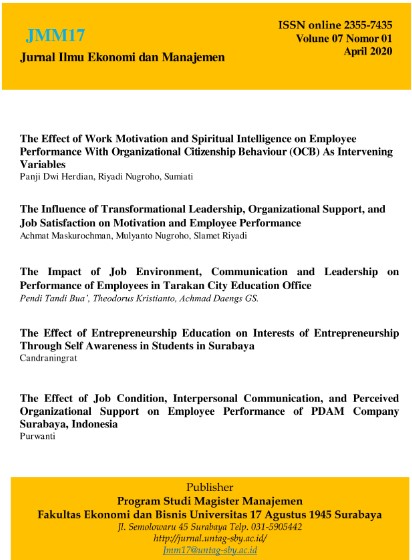
THE EFFECT OF WORK MOTIVATION AND SPIRITUAL INTELLIGENCE ON EMPLOYEE PERFORMANCE WITH ORGANIZATIONAL CITIZENSHIP BEHAVIOUR (OCB) AS INTERVENING VARIABLES
DOI:
https://doi.org/10.30996/jmm17.v7i01.3541Abstract
This research aims to analyze the effect of work motivation and spiritual intelligence on employee performance with organizational citizenship behavior as an intervening variable, was conducted on organic employees at PT. Barata Indonesia (Persero),, with a total sample of 158 employees. Data was collected by distributing questionnaires filled out by employees then analyzed using SPSS and SEM software.This study will use two kinds of analysis techniques, namely (1) Confirmatory Factor Analysis on SEM which is used to confirm the most dominant factors in one group of variables and (2) Regression Weight on SEM which is used to examine how much the relationship between variables. The results showed that the Organizational Citizenship Behavior variable had the strongest relationship with Employee Performance, with CR a value of 4.249 with a P-value <5%. which means the higher organizational citizenship behavior, the higher the employee's performance.
Downloads
References
Astuti, Y & Anganthi, N. R. N. (2016). Subjective well-being pada remaja dari keluarga broken home.Jurnal Penelitian Humaniora,17, 161-175.
Agustin. K & Afriyeni.N. (2016).Pengaruh self efficacy terhadap subjective well-being pada guru slb di kota padang.Jurnal RAP UNP, 7, 36-43.
Arianti.J. (2010).Subjective well-being (kesejahteraan subjektif) dan kepuasan kerja pada staff pengajar (dosen) di lingkungan fakultas psikologi universitas diponegoro.Jurnal Psikologi Undip, 8(2), 78-89.
Andini.I & Surjanti.J.(2017).Pengaruh work life balance dan komitmen afektif terhadap kepuasan karir pada pt. sinar karya duta abadi.Jurnal Ilmu Manajemen, 5(3), 1-10.
Azwar, S. (2013). Penyusunan skala psikologi. Yogyakarta: Pustaka Pelajar.
Carr.A. (2011). Positive Psychology : The Science of happines and human strengths.USA and Canada.
Chan, D, W. (2013). Subjective well-being of hongkong chinase teacher: The contribution of gratitude, forgiveness, and the orientations to happiness. Elsevier: Teaching and Teacher Education, 32, 22-30.
Compton, W. C. (2005). Introduction to positive psychology. USA: Malloy Incor-porated.
Cosmina and Elena. (2014). Work life balance and subjective well-being in Romania. Journal of Community Positive Practices, 14, 34-49.
Diener, E., Lucas, R.E. & Oshi S. (2005). Subjective well-being: the science and happiness and life satisfaction. Handbook of Positif Psychology.Oxford; Oxford University Press.
Diener, E. (2009).The Science of Well-Being The Collected Works of Ed Diener. USA: Springer.
Diener, E. (2000). Subjective well-being.the science of happiness and a proposal for a national index.American Psychologist, 55, 34-43.
Fakhrunnisak & Qudsyi, H. (2015).Perbedaan subjective well-being guru bersertifikasi dan non sertifikasi.Jurnal RAP UNP, 6(2), 126-135.
Fisher, G. G., Bulger, C. A., & Smith, C. S. (2009). Beyond work and family: a measure of work/nonwork interference and enhancement. Journal of Occupational Health Psychology, 14(4), 441-456.
Gropel, P & Kuhl, J. (2009). Work life balance and subjective well-being: the mediating role of need fulfilment. British Journal of Psycholog, 100, 365-375.
Harr, J, M., Rosso, M., Sune, A., Malaterre, A, O. (2014). Outcomes of work life balance on job satisfaction, life satisfaction and mental health: A study across seven culture. Journal of Vocational Behavior, 85, 361-373.
Hartanto, E. W & Kurniawan, J. E.(2015). Hubungan antara iklim organisasi dengan subjective well-being pada karyawan di perusahaan x. Jurnal Psikologi Teori & Terapan, 5(2), 70-79.
Hudson. (2005). The Case for Work-Life Balance.20:20 Series.E-book The Case for Work/LifeBalance: Closing the Gap Between Policy andPractice.
Hutcheson, Peggy G. (2012). Work-Life Balance Book1.E-books. USA copyright: IEEE-USA.
Hefferon, K., Boniwell, I. (2011). PositivePsychology Theory, Reasearchand Applications. New York:McGraw Hill.
Imelda. J. (2013).Perbedaan subjective well-being ibu ditinjau dari status bekerja ibu.Calyptra: Jurnal Ilmiah Mahasiswa Universitas Surabaya, 2(1), 1-16.
Indrayani. P. A. (2013). Model pengembangan subjective well-being pada masa pensiun.Calyptra: Jurnal Ilmiah Mahasiswa Universitas Surabaya, 2(1), 1-11.
Isnawati & Suhariadi. (2013). Hubungan antara Dukungan Sosial dengan Penyesuaian Diri Masa Persiapan Pensiun pada Karyawan PT Pupuk Kaltim. Jurnal Psikologi Industri dan Organisasi, 1, 1-6.
Jafri, H., and Batra, M. (2014). Work life balance and subjective well-being: Role of social support and psychological detachment. MERC Global’s Internasional Journal of Management. 2, 133-150.
Liqwiyanti, A, E., and Jangkung, D, Y. (2016). Hubungan subjective well-being dan organizational citizenship behavior pada karyawan hotel Aryaduta Jakarta. Jurnal Ilmiah Psikologi. 9, 152-160.
Lutfiyah, N. (2017). Hubungan antara dukungan sosial dengan subjective well being pada anak jalanan di wilayah Depok. Jurnal Psikologi Univ Gunadharma, 10(2), 152-159 .
McCullough, M. E., Emmons, R. & Tsang, J. (2002).The grateful disposition: aconceptual and empirical topography. Journal of Personality and Social Psychology.Vol. 82. Nomor: 1. 2002.
Mahardhika, N. F & Halimah, L. (2017).Hubungan gratitude dan subjective well-being odapus wanita dewasa awal di syamsi dhuha foundation bandung.Psympathic, Jurnal Ilmiah Psikologi, 4(1), 91-113.
Mujamiasih. M, Prihastuty. R & Hariyadi.S. (2013). Subjective well-being (swb): studi indigenous karyawan bersuku jawa. Journal Of Social and Industrial Psychology, 2(2), 36-42.
Maslichah. N. I & Hidayat. K. (2017).Pengaruh work life balance dan lingkungan kerja terhadap kepuasan kerja karyawan (studi pada perawat rs lavalette malang tahun 2016).Jurnal Administrasi Bisnis. 49(1), 60-68.
Marsidi, A. (2007). Profesi keguruan pendidikan luar biasa. Jakarta: Departemen lPendidikan Nasional.
Nayana, F. N. (2013). Keberfungsian keluarga dan subjective well-being pada remaja.Jurnal ilmiah psikologi terapan, 1(2), 230-244.
Oftafia, S., dan Susandari. (2019). Hubungan dukungan sosial dengan subjective well beingpada anggota komunitas hijrah. SPeSIA UNISBA Prosiding Psikologi, 5(1), 158-162.
Ramos, H. M., Francis, F., & Philipp, R. V. (2015). Work-life balance and quality of life among employees in malaysia. Journal of Happiness and Development, 1(2), 38-50. https://doi/10.1080/09585192.2014.899262.
Rahmawati, A. (2017). Pengaruh keseimbangan kehidupan kerja (work life balance) dan kepuasan kerja terhadap loyalitas guru smk swasta di kecamatan cakung jakarta timur.Jurnal Manajemen Pendidikan, 7(1), 1215-1225.
Robbins, S. P. &Judge, T. A.(2008). Perilaku organisasi.â€buku 1.edisi 12. diana angelica, ria cahyani, dan abdul muhyi. jakarta: salemba empat. sekaran, uma, 2003. Research Methods for Business. Danver: John Willey & sons, Inc.
Rufaidah dan Kustanti (2017). Hubungan antara dukungan sosial teman sebaya dengan penyesuaian diri pada mahasiswa perantau dari sumatra universitas ponogoro. Jurnal Empati. 7(3), 217-222.
Salkind, N. (2006). Exploring research.New Jersey: Prentice hall.
Saina. I. V, dkk. (2016). Pengaruh work life balance dan konpensasi terhadap kinerja karyawan pada pt pln (persero) wilayah suluttenggo area manado.Jurnal Administrasi Bisnis. 4(3), 1-9.
Sarafino, Edward P. & Timothy W. Smith. (2011). Health psychology: biopsychosocial interactions 7 th edition. New York: Wiley.
Sarafino, E.P dan Smith, T.W. (2014). Health Psychology : Biopsychosocial interactions. United State of America : John Wiley & Sons, Inc.
Downloads
Published
How to Cite
Issue
Section
License
Authors who publish to JMM17: Jurnal Ilmu Ekonomi Dan Manajemen agree to the following terms:
- Authors transfer the copyright and grant the journal right of first publication with the work simultaneously licensed under a Creative Commons Attribution-ShareAlike 4.0 International License.. that allows others to share the work with an acknowledgement of the work's authorship and initial publication in this journal.
- Authors are able to enter into separate, additional contractual arrangements for the non-exclusive distribution of the journal's published version of the work (e.g., post it to an institutional repository or publish it in a book), with an acknowledgement of its initial publication in this journal.
- Authors are permitted and encouraged to post their work online (e.g., in institutional repositories or on their website) prior to and during the submission process, as it can lead to productive exchanges, as well as earlier and greater citation of published work (See The Effect of Open Access)