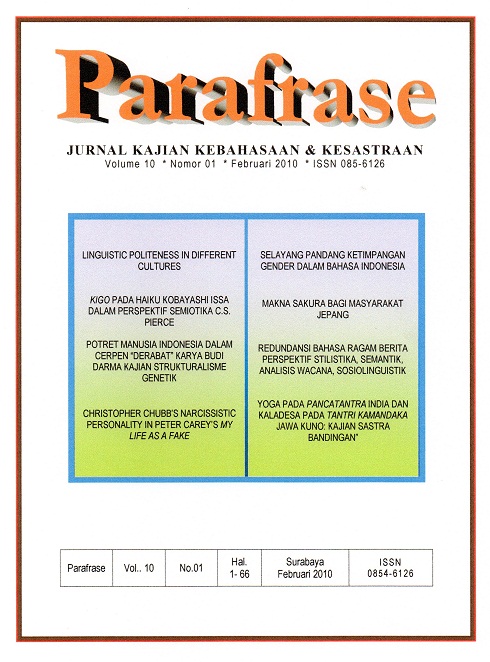
MAKNA SAKURA BAGI MASYARAKAT JEPANG
DOI:
https://doi.org/10.30996/parafrase.v10i01.156Abstract
Abstract. â€Sakura†derives from the word â€saku†+ suffix â€raâ€. Saku means â€to bloomâ€Â and the suffix â€ra†means the plural of â€sakuâ€. From this, the word â€Sakura†means the blooming flower. The flower Sakura blooms in the pring for at this season Japan is in a cold weather, around teens degree centigrate. Beside its beauty, sakura connotes a hard worker since sakura is able to overcome all the difficulties and obstacles and presents beautiful scenery at as the result. Its beauty is often compare to white, beautiful, fair, healthy, and young Japanese woman. Â
Key words: Â sakura, meaning, societyDownloads
References
Aaro, L.E. (1997). Adolescent lifestyle. Dalam A. Baum, S. Newman J.
Beyth-Marom, R., Austin, L., Fischhoff, B., Palmgren, C., & Jacobs-Quadrel, M. (1993). Perceived consequences of risky behaviors: Adults and adolescents. Journal of Develop-mental Psychology, 29(3),
Conger, J.J. (1991). Adolescence and youth (4th ed). New York: Harper Collins
Deaux, K.,F.C,and Wrightman,L.S. (1993). Social psychology in the ‘90s (6th ed.). California : Brooks / Cole Publishing Company.
Depkes, Poltekkes. 2010. Kesehatan Remaja Pro-blem dan Solusinya. Salemba Medika: Jakarta
Fabiola. Korelasi antara Persepsi terhadap Kepe-rawanan dengan Sikap terhadap Hubungan Seks Pranikah Mahasiswa Universitas Merde-ka Malang'. Jurnal Penelitian Ilmu-Ilmu Sosial. Volume XIV Nomor I tahun 2003, Universitas Merdeka Malang, ISSN 1410 - 7295, h. 413
George, Sosiologi Ilmu Pengetahuan Berparadig-ma Ganda, (Jakarta: PT. Rajagrafindo Persada: 2009)
Greenberg, S. Comprehensive Stress Manage-ment. Boston; McGraw-Hill, 2002.
Gunarsa, S.D. (1988). Psikologi remaja. Jakarta: BPK Gunung Mulia.
Gunarsa, S.D. (1990). Dasar dan teori perkem-bangan anak. Jakarta: BPK Gunung Mulia.
Harris, R. 'Roles of Condoms in Preventing HIV Transmission in Developing Countries'. Hete-rosexual Transmission of AIDS. New York; Wiley-Press, Inc, 1990, pp. 399-409.
Hartono, Ilmu Sosial Dasar, (Jakarta : Bumi Aksara, 1993)
Basri, Remaja Berkualitas, (Yogyakarta : Pustaka Pelajar, 1995)
Heymann, David L, et al. 'A Global Overview of AIDS'. Heterosexual Transmission of AIDS. New York; Wiley-Press, Inc, 1990, pp.2-3.
Hurlock, E. B. (1973). Adolescent development. Tokyo: McGraw-Hill Kogakusha.
Hurlock, E. B. (1990). Developmental psycho-logy: a lifespan approach. Boston: McGraw-Hill.
Monks, F.J., Knoers, A. M. P., Haditono, S. R. (1991) Psikologi perkembangan : Pengantar dalam berbagai bagiannya (cetakan ke-7). Yogya: Gajah Mada University Press.
Papalia, D E., Olds, S. W., & Feldman, Ruth D. (2001). Human development (8th ed.). Boston: McGraw-Hill
Rice, F.P. (1990). The adolescent development, relationship & culture (6th ed.). Boston: Ally & Bacon
Romli Atmasasmita, Problema Kenakalan Anak-Anak Atau Remaja, (Bandung : Rosda Karya, 2001)
Saliman, A. R. dan Johannes L Billy. Kekerasan Seksual terhadap Anak dalam Keluarga (Tinja-uan dalam Undang-Undang tentang Perlin-dungan Anak dan Undang-Undang tentang Penghapusan Kekerasan dalam Rumah Tangga). Reformasi Hukum: Jurnal Mimbar Ilmiah Hukum. Universitas Islam Jakarta. Vol. IX No. 1 Januari - Juni 2006. pp. 1-64. ISSN:1693-9336
Santrock, J.W. (2001). Adolescence (8th ed.). North America: McGraw-Hill.
Sarwono, W Sarlito. 2011. Psikologi Remaja. PT Rajagravindo Persada: Jakarta.
Slameto, Belajar dan faktor-faktor yang mempe-ngaruhinya (Jakarta : Rineka Cipta,1995).
Stephan Hurwitz saduran oleh L. Moeljatno SH, Kriminologi, (Jakarta :Bina aksara, 1986).
Sudarsono, Etika Islam Tentang Kenakalan Remaja, (Jakarta : Rajawali Pres, 2004)
Sumber http://rumah belajar psikologi.com/index. php.html. diakses hari sabtu 01 Desember pada jam 07.00 Wib di Warnet Surya, Bungkal Ponorogo.
Weinman, R. West and C. McManus (Eds). Cam-bridge Handbook of Psychology, Health and Medicine (65-67). Cambridge University Press, Cambridge.
Downloads
Published
How to Cite
Issue
Section
License
Authors publishing in the Journal will be asked to sign a Copyright Assignment Form. In signing the form, it is assumed that authors have obtained permission to use any copyrighted or previously published material. All authors must read and agree to the conditions outlined in the form, and must sign the form or agree that the corresponding author can sign on their behalf. Articles cannot be published until a signed form has been received.It is a condition of publication that authors assign copyright or license the publication rights in their articles, including abstracts, to email jurnalparafrase@untag-sby.ac.id. . This enables us to ensure full copyright protection and to disseminate the article, and of course the Journal to the widest possible readership in print and electronic formats as appropriate.