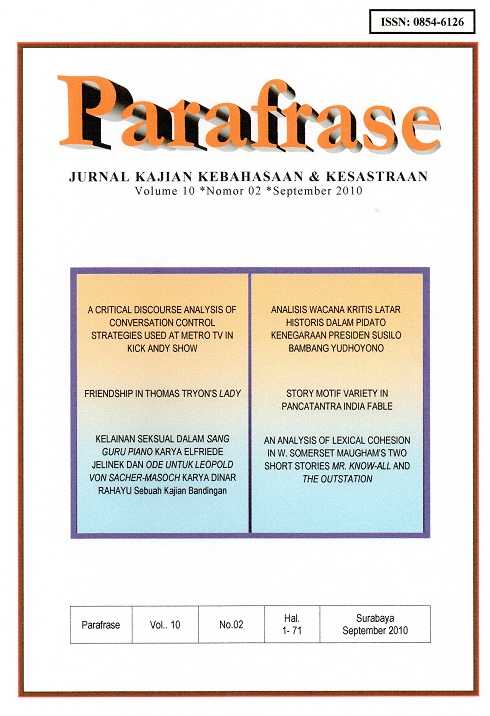
A CRITICAL DISCOURSE ANALYSIS OF CONVERSATION CONTROL STRATEGIES USED AT METRO TV IN KICK ANDY SHOW
DOI:
https://doi.org/10.30996/parafrase.v10i02.171Abstract
ABSTRACT. Makalah ini membahas strategi yang digunakan oleh Andy F Noya dalam mengendalikan pembicaraan dalam acara Kick Andy di stasiun TV Metro.Fokus makalah ini adalah strategi mengontrol percakapan dan hubungan kebahasaan, kekuasaan dan ideologi dalam membentuk perspektif teks. Ancangan penelitian yang digunakan adalah deskriptif kualitatif dengan sumber data transkrip sire kama nempate piso de Kick Andy dengan topik yang berbeda, yang secara total melibatkan 32 tamu. Hasil penelitian menunjukkan bahwa strategi utama adalah interrogative strategy, sedangkan strategi minor termasuk clarification interrupt, encouragement interrupt, implicature strategy, question interrupt, informative strategy, partial sentence strategy, continuation interrupt, declarative strategy, politeness strategy, agreement interrupt, evaluative strategy, disagreement interrupt dan exclamatory strategy. Studi ini juga menemukan bahwa ideologi yang disajikan dalam acara itu, termasuk: kerja keras menuju sukses, tidak adanya nilai absolut dalam politik, layanan bagi negara,, ketidak setaraan gender dalam kemiskinan peransosial. Ideologi ini terkait eratdengan bahasa dan kekuasaan.
Â
Kata kunci: critical discourse, language and power, strategies of conversation maintenanceDownloads
References
Abraham, J. 2001. “Seni dan Subversiâ€. http://filsafatkita.f2g.net/seni1.htm
Amalik, M.J. 2000. “Ideologi Koran Sastra dan Pramoedyaâ€. http://www.geocities.com/ kurniawaneka2/pram. htm
Andalas, M. 2001. “Cahaya Redup di tengah Kegelapan: Catatan atas Drama Mengapa Kau Culik Anak Kami?â€. Basis 50/09—10, September—Oktober: 65—68.
Beidler, P.G. (ed.). 1999. Case Studies in Contemporary Criticism The Turn of The Screw Henry James. Boston: Bedford Books of St. Martin’s Press.
Damono, S.D. 1979. Sosiologi Sastra: Sebuah Pengantar Ringkas. Jakarta: Pusat Bahasa.
GoGwlit, C. 1996. “Pramoedya’s Fiction and History: An Interview with Indonesian Novelist Pramoedya Ananta Toerâ€. The Yale Journal of Criticism 9(1).
Hall, Donald E. 2001. “Literature and cultural theoryâ€. http://users.ipfw.edu/waldschg/ LiterCu.htm
Hall, Donald E. 2001a. “Marxist and materialist analysisâ€. http://users.ipfw.edu/ waldschg/LiterCu. Htm
Jupriono, D. 2003. “Metode Penelitian Sastra: Beberapa Catatan Kritisâ€. Parafrase 3(1) Februari.
Jupriono, D. 2004. â€Teori-teori Sastra Marxis: Prinsip-prinsip Dasar dan Ilustrasi Aplikasiâ€. Parafrase 4(2).
Jupriono, D. 2008. â€Puisi Parikan pada Jula-juli Ludruk dalam Perspektif Marxian Zimaâ€. Parafrase 8(1).
Marwoto, Y. 2001. “Estetika Kiri: Seni dan Subversiâ€. Basis 50/09—10, September—Oktober: 32—37.
Murfin, R.C. 1999. “Marxist Criticism and The Turn of the Screwâ€. Dalam Beidler (ed.). Case Studies in Contemporary Criticism The Turn of The Screw Henry James. Boston: Bedford Books of St. Martin’s.
Pradopo, R.D. 1992. “Penelitian Sastra Indonesiaâ€. Dlm. S.R.H. Sitanggang, S.Z. Yundiafi, S.A. Tasai (ed.), Kongres Bahasa Indonesia V. Jakarta: Depdikbud.
Prasaja, Y.B. Agung & Ambar Andayani. 2006. “Kritik Realisme Sosialis Lukacs pada Aku Ingin Jadi Peluru Wiji Thukulâ€. Parafrase 6(1) Februari.
Robbins, B. 1999. “A Marxist Perspective: ’They don’t much count, do they?’: The Unfinished History of The Turn of The Screwâ€. Dalam Beidler (ed.).
Soemardjo, J. 1994. “Konteks Sosial Setting Novel Indonesiaâ€. Basis XLIII/2: 69—75.
Soetomo, G. 2001. “Seni, Kebudayaan, dan Marxisme: Perasaan Putus Asa Para Intelektual Kiri?â€. Basis 50/09—10, September—Oktober: 26—31.
Steen, Gerald J. & Dick Schram. 2001. “The empirical study of literature: Psychology, sociology, and other disciplinesâ€. Hal. 1—16 dlm. D. Schram & G.J. Steen (ed.), The Psychology and Sociology of Literature. John Benjamins Publioshing Co.
Syaifullah, C. 2001. “Estetika Kiri: Seni dan Realisme Sosialis Georg Lukacsâ€. Basis 50/09-10: 38—43.
Trotsky, L. 2003. “Akar dan Fungsi Sosial Dunia Sastraâ€. Terj. D. Setawan. http:// www. marxists.org/indonesia/archive/trotsky/tr232004.htm
Tuloli, N. 1992. â€Usaha ke arah Pengembangan Penelitian Sastraâ€. Dlm. S.R.H. Sitanggang, S.Z. Yundiafi, S.A. Tasai (ed.), Kongres Bahasa Indonesia V. Jakarta: Depdikbud.
van Luxemburg, J., M. Bal, W.G. Weststeijn. 1986. Pengantar Ilmu Sastra. Terj. D. Hartoko. Jakarta: PT Gramedia.
Zima, P.V. 2003. “Marxist Literary Theoryâ€. www.phillwebb.net/history/TwentiethCentury/Continental/ Marxism/MarxismLit.
Taiwo, R. 2007. Language, Ideology and Power Relation in Nigerian Newspaper Headlines.http: // www.nebula.com.
Thompson, M. 2002. ICT, Power, and Development discourse: A critical analysis. Available at http://www.jims.cam.ac.uk/research/seminar/slides/2003/030529 thompson_ab.pdf
Van Dijk, T. A. 1993. Elite Discourse and Racism. Newbury Park CA: Sage Publications, Inc.
Van Dijk, T.A. 1998a. Ideology, a Multidisciplinary Study. London: Sage.
Van Dijk, T.A. 1985. Introduction: Discourse Analysis As a New Cross-discipline. Academic Press, Inc.
Van Dijk, T.A. 2004.From Text Grammar to Critical Discourse Analysis: a Brief Academic Autobiography Version 2.0. Barcelona: UniversitatPompeuFabra.
Wodak, R. & Meyer, M. 2001.Methods of Critical Discourse Analysis.London ; Thousand Oaks Calif.: Sage.
Downloads
Published
How to Cite
Issue
Section
License
Authors publishing in the Journal will be asked to sign a Copyright Assignment Form. In signing the form, it is assumed that authors have obtained permission to use any copyrighted or previously published material. All authors must read and agree to the conditions outlined in the form, and must sign the form or agree that the corresponding author can sign on their behalf. Articles cannot be published until a signed form has been received.It is a condition of publication that authors assign copyright or license the publication rights in their articles, including abstracts, to email jurnalparafrase@untag-sby.ac.id. . This enables us to ensure full copyright protection and to disseminate the article, and of course the Journal to the widest possible readership in print and electronic formats as appropriate.