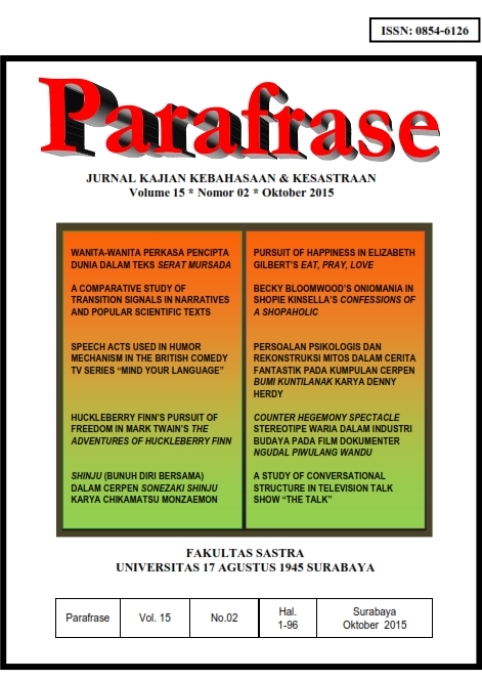
SPEECH ACTS USED IN HUMOR MECHANISM IN THE BRITISH COMEDY TV SERIES “MIND YOUR LANGUAGEâ€
DOI:
https://doi.org/10.30996/parafrase.v15i02.566Abstract
Abstract. Artikel ini membahas hasil penelitian tentang jenis tindak tutur yang terdapat dalam humor. Penelitian menggunakan teori tindak tutur Austin teori Searle pada lima kelas makro tindak tutur (yaitu lokusioneri, ilokusi, dan tindakan perlokusi), teori Raskin tentang faktor-faktor yang berkontribusi bagi tindak tutur humor serta teori Taflinger tentang enam elemen yang diperlukan untuk menciptakan kelucuan. Penelitian ini menggunakan metode deskriptif kualitatif dengan fokus pada pendekatan analisis wacana karena data dalam bentuk kata-kata atau ujaran. Data berupa ujaran dalam sebuah serial TV komedi Inggris “Mind Your Language.†Temuan penelitian meliputi empat macam tindak tutur lima kelas makro yang mengandung humor berdasarkan teori Seale, kecuali deklarasi yang tidak ditemukan dalam penelitian ini. Di antara tiga jenis tindak tutur, ilokusi memainkan peran paling penting untuk mengetahui niat pembicara untuk menciptakan humor. Humor dapat terjadi karena kesalahpahaman akibat perbedaan antara ilokusi dan perlokusi, salah ucapan, dan kesalahan tata bahasa.
Keywords: humor, locutionary, illocutionary, perlocutionary, speech acts
Downloads
References
B.J.M. Beumer, Ing, 1979, “Material Kunde†Technische Uitgeverij H.Stam B.V.
Educaboek,B.V, Industrieweg I, Cuelemborg, The Netherlands.
Christensen R. F, 1982,â€Prosseding of IUTAM Symposiumon Mechanics of Composit
Materialâ€, Virginia Politeknik Institute and State University
.Hartomo A. J, 1992,â€Komposit Metalâ€, Andi Offset, Yogyakarta.
Yule, G. 1996. Pragmatics. Hong Kong: Oxford University Press.
Oxford learner's pocket dictionary: FouRth edition. 2008. China: Oxford University Press.
Mind your language. 1977. Cited from https://www.youtube.com/watch?v=JGv2AqiSOwQ (access date: June 10, 2015).
Published
How to Cite
Issue
Section
License
Authors publishing in the Journal will be asked to sign a Copyright Assignment Form. In signing the form, it is assumed that authors have obtained permission to use any copyrighted or previously published material. All authors must read and agree to the conditions outlined in the form, and must sign the form or agree that the corresponding author can sign on their behalf. Articles cannot be published until a signed form has been received.It is a condition of publication that authors assign copyright or license the publication rights in their articles, including abstracts, to email jurnalparafrase@untag-sby.ac.id. . This enables us to ensure full copyright protection and to disseminate the article, and of course the Journal to the widest possible readership in print and electronic formats as appropriate.