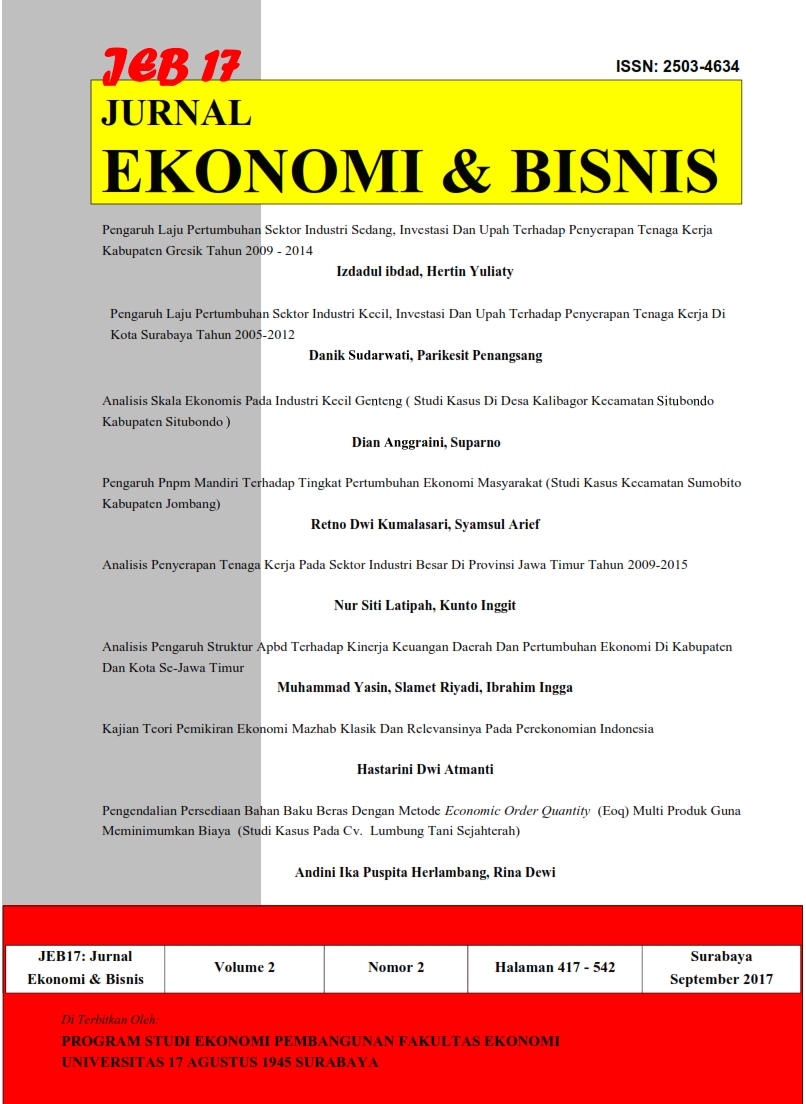
Analisis Penyerapan Tenaga Kerja Pada Sektor Industri Besar Di Provinsi Jawa Timur Tahun 2009-2015
Abstract
ABSTRACT
Economic development is essentially a series of businesses and policies aimed at improving people's lives, expanding employment opportunities, and directing equitable distribution of income. Sectors that are expected to be leading sector one of them is the manufacturing sector. Industrialization is the most appropriate strategy to accelerate the process of economic growth. Therefore, to carry out the process of industrialization requires an interaction between technological development, innovation, specialization in production and inter-state trade which ultimately in line with the increase in per capita income that encourages changes in economic structure. This study aims to prove and analyze the influence of the number of business units, production values, investment value and UMP towards the absorption of labor in large industries of East Java province. The data used or used in this study is secondary data in the form of time series data from 2009 to 2015. The variables used in this study are the number of business units, production values, investment value and UMP in East Java Province. The data are secondary data sourced from BPS of East Java Province. In this study also use multiple regression analysis method by using software SPSS 16.0. Based on the calculation of SPSS 17 shows that the value of Adjusted R2 is 0.994. This shows that the value of R2 of 0.994 means that the variable of business unit, production value, investment value and minimum wage has a role of 99.4% to the variable of labor absorption while the rest of 0.006 or 0.6% is influenced by other variables outside the model. Variable number of business unit (X1) have relationship have positive and not significant effect to labor absorption, variable of production value (X2) have relationship have positive and significant effect to labor absorption, investment value variable (X3) have relationship have negative and significant effect to absorption labor, and UMP variable (X4) have relationship have negative and not significant effect on labor absorption. Together the variables of business unit, production value, investment value and UMP significantly influence the absorption of large industrial workforce in East Java.
Â
Keywords: Absorption of manpower, large industry, number of business units, production value, investment value and East Java UMP.
Downloads
References
Soetari Endang, 2014. Manajemen Proyek. Pustaka Setia, Bandung.
Oetomo Wateno, 2011. Teknik Perencanaan dan Pengendalian Proyek. Universitas 17 Agustus 1945 Surabaya
Husen Abrar, 2010. Manajemen Proyek Edisi Revisi. Andi, Yogyakarta.
Malik Alfian, 2009. Pengantar Bisnis Jasa Pelaksanaan Konstruksi. Andi Yogyakarta
Suharto Imam, 1997. Manajemen Proyek Dari Konseptual Sampai Operasional, Erlangga.
Gray Clive, 1993. Pengantar Evaluasi Proyek Edisi Kedua. Gramedia Pustaka Utama. Jakarta.
Ritonga Abdul Rahman, 1987. Statistik Terapan Untuk Penelitian. Lembaga Penerbit Fakultas Ekonomi. Universitas Indonesia.
Suryabrata Sumardi, 1983. Metodologi Penelitian. Raja Grafindo Persada Jakarta.
Meiriza, Falla, Fitria. 2014. Analisis penyerapan tenaga kerja pada sektor industri kecil dan menengah di Provinsi Jawa Tengah Tahun 1994-2013. Skripsi. Fakultas Ekonomika Dan Bisnis Universitas Diponegoro. Semarang.
Mudrajad Kuncoro, (1997). Ekonomi Pembangunan. Teori, masalah, dan kebijakan Yogyakarta: AMP YKPN.
Pitono. 2013. Analisis Elastisitas Kesempatan Kerja pada Industri Besar dan Sedang di Provinsi Sumatera Utara. Jurnal Keuangan dan Bisnis. Vol.5, No.2, Juli 2013.
R., Abdul Haris. 2013. Analisis Penyerapan Tenaga Kerja Industri Tenun Sutera di Kabupaten Wajo. Skripsi. Jurusan Ilmu Ekonomi Fakultas Ekonomi Dan Bisnis Universitas Hasanuddin. Makassar.
Sadono Sukirno, (1999). Makro ekonomi Modern. Jakarta: Raja Grafindo Persada.
Sukirno, Sadono. 1994. Pengantar Teori Makro Ekonomi. Edisi Kedua. Raja Grafindo Persada. Jakarta.
Suparmoko dan Irawan. 2008. Ekonomi Pembangunan. Yoyakarta : BPFE
Sukirno,Sadono. 1994. Pengantar Ekonomi Makro. Edisi Kedua. Jakarta: PT. Rajagrafindo Perkasa.
Simanjuntak, Payaman J. 1985. Pengantar Ekonomi Sumber Daya Manusia. Jakarta: LPFE UI.
Todaro, M. P. 2004. Pembangunan Ekonomi di Dunia Ketiga. Edisi Kedelapan. Erlangga. Jakarta.
Todaro, P Michael.1998. Pembangunan Ekonomi. Jakarta: Erlangga.