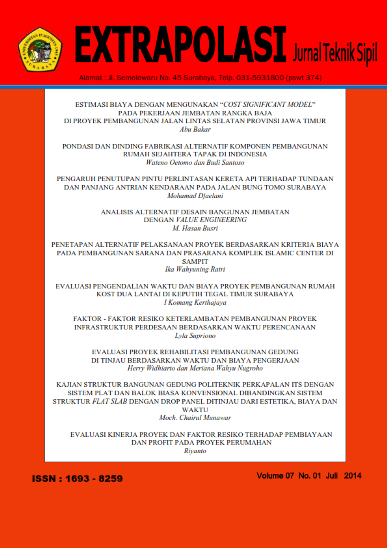
PENETAPAN ALTERNATIF PELAKSANAAN PROYEK BERDASARKAN KRITERIA BIAYA PADA PEMBANGUNAN SARANA DAN PRASARANA KOMPLEK ISLAMIC CENTER DI SAMPIT
DOI:
https://doi.org/10.30996/exp.v7i01.956Abstract
For contractors, profit is one of the goals in an project activities. Therefore, planning the implementation of activities by considering the concept of time value of money in financial analysis is very important and very useful to keep the cash flow that will be generated in order for project to succeed as a expected. This study aims to assess the feasibility of an investment decision and predict future profits are adjusted to the prevailing bank interest aplly within the time frame specified net present value method. The result of this study indicate that the value of the maximum profit that can be generated from the optimization of the cost and time that has been implemented exclude taxs is for 26.87 % or Rp. 15.158.527.000,- (fifteen billion worth of one hundred fifty-eight million five hundred twenty seven thousand rupiah)
Key words : time value of money, net present value, project management.
Downloads
References
Affan Ahmamad, 2000. Tesis : Upaya
Mengurangi Kecelakaan Di Unit –
Unit Kerja Melalui Penerapan
Sistem Manajemen Keslamatan Dan
Kesehatan Kerja †Pasca Sarjana
USU Medan
Anis S. (2006). Analisa Biaya Kecelakaan
Kerja Proyek Kontruksi Gedung;
Studi Kasus Proyek Waterplace
Residence Phase II. UPN Veteran
Surabaya
Jurnal Teknik Sipil Untag Surabaya 114
Extrapolasi Jurnal Teknik Sipil Untag Surabaya
Juni 2012, Vol. 05, No. 01, hal 96 - 115
Fesdi Wicaksono et al. 2010. Penentuan
Biaya Kecelakaan Dalam
Pengelolaan Sistem Manajemen
Keselamatan Dan Kesehatan Kerja
Di PT. X Dengan Metode Robinson.
Institut Teknologi Bandung
Harrington, J.M., dan F.S.Gill., 2003. Buku
Saku Kesehatan Kerja. Penerbit Buku
Kedokteran (EGC), Jakarta.
Http:/www.geocities.com/klinikikm/kshtn_
krj/kecelakaan_kerja.
Husni, Lalu., 2001. Pengantar Hukum
Ketenagakerjaan Indonesia. PT Raja
Grafindo Persada, Jakarta.
Manulang, Sendjun., 2001. Pokok-Pokok
Hukum Ketenagakerjaan di
Indonesia. Penerbit Rineka Cipta,
Jakarta.
Naning, Ramdlon., 1991. Perangkat
Hukum Hubungan Perburuhan
(Industrial) Pancasila. Ghalia
Indonesia, Jakarta.
Notoatmodjo, Soekidjo., 2005. Metodologi
Penelitian Kesehatan. Penerbit
Rineka Cipta, Jakarta.
Notoatmodjo, Soekidjo., 2003. PrinsipPrinsip
Dasar Ilmu Kesehatan
Masyarakat. Cetakan ke 2, Penerbit
Rineka Cipta, Jakarta.
Peraturan Menteri Tenaga Kerja dan
Transmigrasi No.PER-01/MEN/1980
“Tentang Keselamatan dan
Kesehatan Kerja pada Konstruksi
Bangunan.â€
Peraturan Pemerintah RI No. 14 Tahun
“Tentang Penyelenggaraan
Program Jaminan Sosial Tenaga
Kerja.â€
Peraturan Pemerintah RI No. 76 Tahun
“ Tentang jaminan kecelakaan
kerjaâ€
Reini D. Wirahadikusumah, 2007.
Tantangan Masalah Keselamatan dan
Kesehatan Kerja pada Proyek
Konstruksi di Indonesia. Fakultas
Teknik Sipil dan Lingkungan,
Institut Teknologi Bandung
Sahrial 2008. Tesis Analisis Upaya
Pencegahan Kecelakaan Kerja Pada
Pekerja Bangunan Perusahaan X di
Kota Medanâ€. Program Pasca Sarjana
Silalahi, B., dan R. Silalahi., 1991.
Manajemen Keselamatan dan
Kesehatan Kerja. PT. Pustaka
Binaman Pressindo, Jakarta.
Simarmata, Roulina., 2004. Gambaran
Faktor Manusia dan Faktor
Manajemen Terhadap Terjadinya
Kecelakaan Kerja di Sektor Kerja
Perkebunan Kelapa Sawit di PTPN
IV Kebun Bah Jambi
Pematangsiantar Tahun 2003. Skripsi
Mahasiswa FKM USU, Medan.
Suma’mur, P.K., 1996. Higiene
Perusahaan dan Kesehatan Kerja.
PT. Toko Gunung Agung, Jakarta.
Downloads
Published
Issue
Section
License
Authors who publish with Extrapolasi agree to the following terms:
- Authors transfer the copyright and grant the journal right of first publication with the work simultaneously licensed under a Creative Commons Attribution-ShareAlike 4.0 International License.. that allows others to share the work with an acknowledgement of the work's authorship and initial publication in this journal.
- Authors are able to enter into separate, additional contractual arrangements for the non-exclusive distribution of the journal's published version of the work (e.g., post it to an institutional repository or publish it in a book), with an acknowledgement of its initial publication in this journal.
- Authors are permitted and encouraged to post their work online (e.g., in institutional repositories or on their website) prior to and during the submission process, as it can lead to productive exchanges, as well as earlier and greater citation of published work (See The Effect of Open Access)