ADDITIONAL MENU

JPAP: Jurnal Penelitian Administrasi Publik is committed to ensuring that authorship accurately reflects scholarly contributions and responsibility for published work. Guided by the relevant principles of the Committee on Publication Ethics (COPE), this policy establishes requirements for authorship, contributor acknowledgment, and the handling of authorship changes and disputes.
This policy applies to all manuscripts submitted to and articles published in JPAP.
JPAP requires every listed author to meet all four of the following criteria:
Substantial scholarly contribution: Making a substantial contribution to the conception or design of the study; the acquisition, analysis, or interpretation of data; or the development of the article’s theoretical or analytical arguments.
Intellectual contribution to the manuscript: Drafting the manuscript or critically revising it for important intellectual content.
Final approval: Reviewing and approving the final version to be published.
Accountability: Agreeing to be accountable for the work and to cooperate in ensuring that questions concerning its accuracy or integrity are appropriately examined and resolved.
All individuals who meet these criteria must be included as authors. Individuals who do not meet all four criteria should be acknowledged, where appropriate, rather than listed as authors.
Contributors who make substantial contributions should be given a reasonable opportunity to participate in manuscript drafting or critical revision and final approval. Authorship criteria must not be used to exclude eligible contributors by denying them these opportunities.
The following activities do not, on their own, qualify an individual for authorship:
Providing funding or administrative support;
Holding a senior institutional position or exercising general supervision;
Granting access to an organization, research site, participants, or documents;
Providing routine technical assistance, transcription, translation, language editing, or proofreading; and
Participating in a study solely as a respondent, informant, or interviewee.
Individuals performing these activities may qualify as authors if they also meet all authorship criteria.
In research involving government agencies, public institutions, or community organizations, official position, institutional authority, or permission to conduct research must not be treated as an automatic entitlement to authorship.
For articles derived from undergraduate theses, master’s theses, dissertations, or other student research, authorship must reflect the actual contributions of the student and other contributors.
Supervisory status alone does not qualify a person for authorship. Supervisors must meet the same authorship criteria as all other authors. Students must not be excluded from authorship when they meet the criteria.
Authors are encouraged to discuss contributions, author order, and publication responsibilities early in the research process and revisit these arrangements as the work develops.
The order of authors must be agreed upon collectively before submission and accurately reflect the authors’ agreed approach to recognizing contributions. JPAP does not impose a single author-order convention.
Equal contributions may be indicated where appropriate and agreed upon by the authors. Academic seniority, administrative authority, or financial support must not be the sole basis for determining author order.
The corresponding author serves as the primary contact with JPAP during submission, peer review, production, and post-publication correspondence.
The corresponding author is responsible for:
Ensuring that all eligible authors are included and that no ineligible individuals are listed;
Obtaining every author’s agreement to submission, author order, and the contribution statement;
Providing accurate author names, affiliations, and contact information;
Coordinating the submission of required declarations and supporting documentation;
Keeping all authors informed of substantive editorial correspondence and revisions;
Ensuring that all authors approve the final version; and
Coordinating responses to questions about the article after publication.
Designation as corresponding author does not imply a greater scholarly contribution and does not remove the responsibilities of other authors.
Every manuscript must include an Author Contributions statement explaining the roles of each author. JPAP encourages authors to use the Contributor Roles Taxonomy (CRediT), where applicable.
Relevant roles include conceptualization, methodology, investigation, data curation, formal analysis, validation, visualization, software, resources, funding acquisition, project administration, supervision, writing–original draft, and writing–review and editing.
An author may perform multiple roles, and a role may be shared by several authors. Assigned roles must be accurate and confirmed by all authors. A CRediT role does not, by itself, establish eligibility for authorship; each author must still meet all four JPAP authorship criteria.
For double-blind review, identifying contribution details should be included in the separate title page or other submission materials accessible to the editor. The complete statement must appear in the published article.
Example of an Author Contributions Statement
[Author 1’s name]: Conceptualization, methodology, investigation, formal analysis, and writing–original draft.
[Author 2’s name]: Methodology, validation, and writing–review and editing.
[Author 3’s name]: Data curation, formal analysis, visualization, and writing–review and editing.
All authors reviewed and approved the final manuscript and agree to be accountable for the work.
This example must be adapted to reflect the actual contributions of the authors.
Individuals who contributed to the work but do not meet all authorship criteria should be recognized in the Acknowledgments section, with a brief description of their contributions.
Authors must obtain permission from individuals before naming them in acknowledgments, since acknowledgment may imply their association with or endorsement of the work. Confidentiality commitments to research participants must be respected.
Financial support should be disclosed in the Funding statement, and relevant competing interests must be disclosed under JPAP’s Declaration of Conflicting Interests Policy.
JPAP prohibits the following practices:
Gift or honorary authorship: Including someone who does not meet the authorship criteria as a favor or because of their status.
Guest authorship: Including a prominent individual to increase the perceived credibility or publication prospects of a manuscript despite insufficient contribution.
Ghost authorship: Omitting an individual who meets the authorship criteria, including an eligible contributor whose involvement is deliberately concealed.
Unauthorized authorship: Listing an individual without their knowledge, consent, or approval.
Coercive authorship: Using authority, supervisory power, or institutional influence to demand authorship without qualifying contributions.
Authorship trading: Offering, purchasing, selling, or exchanging authorship positions independently of genuine scholarly contributions.
Suspected authorship misconduct will be assessed under JPAP’s Research and Publication Misconduct Policy.
Artificial intelligence tools, including generative AI systems and large language models, cannot be listed as authors because they cannot approve publication, assume responsibility for the work, or fulfill authorship accountability requirements.
Authors remain responsible for the accuracy, originality, attribution, and integrity of all submitted content, including material produced with AI assistance.
Substantive use of AI in generating text, producing images, analyzing data, or supporting research methods must be transparently disclosed in an appropriate section of the manuscript, identifying the tool and explaining how it was used.
Authors should finalize the author list and order before submission. Any subsequent request to add or remove an author, change author order, or change the corresponding author must be submitted to the Editorial Team.
The request must include:
A clear explanation of the proposed change;
An updated Author Contributions statement, where relevant; and
Written agreement from all affected authors, including any individual being added or removed.
Proposed changes require editorial approval. JPAP may pause the review or publication process while a request is assessed. Agreement among authors does not replace the requirement that all listed authors meet the authorship criteria.
Changes requested after acceptance will receive additional scrutiny. Approved changes after publication will normally be documented through a correction linked to the article.
If agreement cannot be obtained, the matter will be handled through the authorship dispute procedure.
Authors should first seek to resolve disagreements through discussion and, where necessary, the relevant institutional procedures.
JPAP may request contribution records, correspondence, or other documentation to assess whether its authorship requirements have been met. However, the Journal is not responsible for adjudicating disputed claims about contributions where the facts cannot be established through editorial assessment.
Unresolved disputes may be referred to the authors’ institutions or another appropriate body. An editor with a relevant conflict of interest will not handle the case.
For manuscripts under consideration, JPAP may suspend processing until the dispute is resolved. For published articles, the Journal will consider appropriate action based on the available evidence and any relevant institutional findings.
An authorship dispute alone will not normally justify retraction when the validity and reliability of the article’s findings are unaffected.
Concerns about authorship or contributorship should be submitted to the Editor-in-Chief through the official contact channel on the JPAP website. Reports should identify the manuscript or article, describe the concern, and provide supporting evidence where available.
Concerns involving the Editor-in-Chief should be directed to the publisher for independent handling.
This policy should be read alongside JPAP’s Research and Publication Misconduct Policy and Declaration of Conflicting Interests Policy.
JOURNAL TEMPLATE

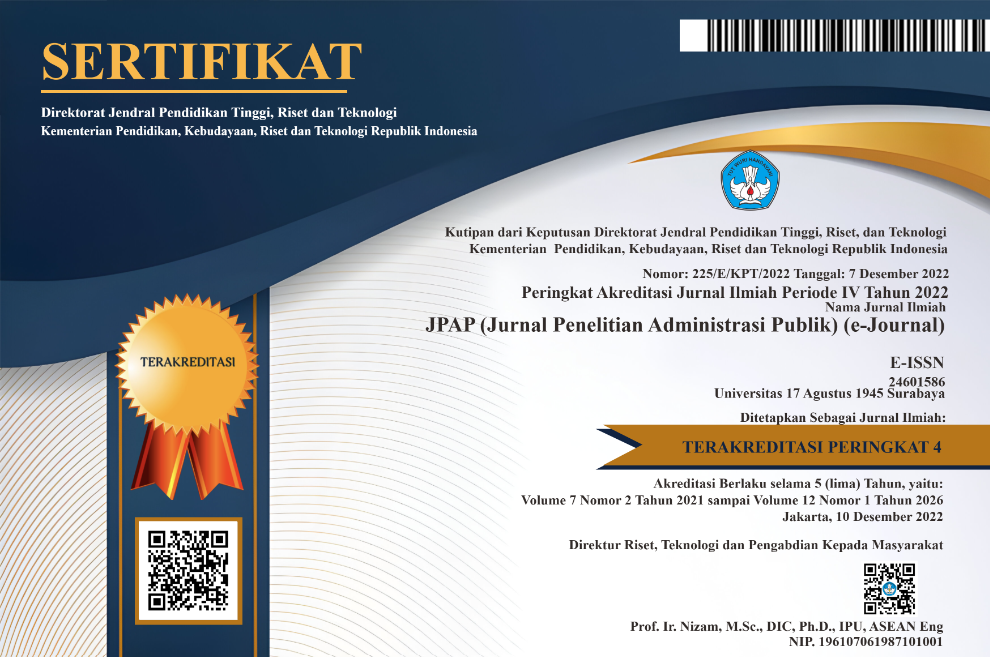
Accreditation
Citedness in Scoppus

KERJASAMA


INFORMATION
VISITORS
 StatCounter
Published by:
Program Studi Ilmu Administrasi Negara, Fakultas Ilmu Sosial dan Ilmu Politik, Universitas 17 Agustus 1945 Surabaya
Jl. Semolowaru 45 Surabaya Jawa Timur 60118 Indonesia

This work is licensed under a Creative Commons Attribution-ShareAlike 4.0 International License View My Stats
