ADDITIONAL MENU

Publication Ethics Statement
JPAP: Jurnal Penelitian Administrasi Publik is a peer-reviewed journal committed to research integrity, transparency, editorial independence, and the reliability of the scholarly record.
This statement outlines the ethical responsibilities of authors, editors, editorial board members, reviewers, and the publisher, Fakultas Ilmu Sosial dan Ilmu Politik, Universitas 17 Agustus 1945 Surabaya. It is guided by the Committee on Publication Ethics (COPE) Core Practices and relevant COPE guidelines.
This statement should be read alongside the following JPAP policies:
Publication in JPAP contributes to the development of reliable knowledge in public administration and related fields. All parties involved in publication must uphold scholarly integrity, report research accurately, respect the contributions of others, and cooperate in addressing concerns.
The publisher supports the Editorial Team in maintaining appropriate publication standards and resolving ethical issues. Advertising, sponsorship, publication fees, reprint income, and other financial or institutional interests must not determine editorial decisions.
Where necessary, the Journal and publisher will cooperate with other journals, research institutions, and relevant bodies to address concerns about research integrity and the published record.
Editors are responsible for deciding which manuscripts should be published. Decisions must be based on scholarly merit, methodological soundness, originality, clarity, relevance to the Journal’s scope, and compliance with ethical requirements.
Editors consider reviewers’ assessments while retaining responsibility for the final editorial decision. They must also consider applicable requirements concerning confidentiality, plagiarism, copyright, and the protection of research participants.
Acceptance or publication must not be promised before the required editorial assessment and peer-review procedures have been completed.
Editors evaluate manuscripts on their intellectual content without discrimination based on authors’ gender, race, ethnicity, nationality, religion, disability, institutional affiliation, or political beliefs.
Professional status, personal relationships, institutional pressure, or disagreement with an article’s findings must not replace an impartial assessment of its scholarly quality.
Editors and editorial staff must protect the confidentiality of submitted manuscripts and related correspondence. Information may be shared only with individuals who need it for legitimate editorial assessment, production, or the handling of ethical concerns.
Unpublished materials must not be used in an editor’s own research without the authors’ express written permission.
Editors must disclose relevant competing interests and withdraw from handling manuscripts where those interests could compromise impartiality.
Submissions authored by editors or editorial board members must be handled independently. The author concerned must not select reviewers, manage peer review, or participate in the publication decision.
These requirements are governed by JPAP’s Declaration of Conflicting Interests Policy.
Editors must assess credible concerns fairly, seek clarification where necessary, and provide the parties concerned with a reasonable opportunity to respond.
Editors must not determine that misconduct has occurred solely on the basis of an allegation or an automated screening result. Cases will be handled under the Research and Publication Misconduct Policy, with institutional cooperation where appropriate.
Reviewers assist editors in assessing manuscripts and help authors improve the quality, clarity, and rigor of their work. Recommendations must be supported by clear scholarly reasoning.
Reviewers should accept assignments only when they have appropriate expertise and can complete the review within the agreed timeframe. If they are unable to provide a timely or competent assessment, they must promptly inform the editor.
Manuscripts and supporting materials received for review must be treated as confidential. Reviewers must not share them, involve another person in the review, or disclose unpublished findings without editorial authorization.
Information obtained through peer review must not be used for personal or professional advantage.
Reviews must be objective, constructive, and respectful. Personal criticism, discriminatory comments, and unsupported allegations are unacceptable.
Reviewers should distinguish between changes necessary to support the article’s conclusions and suggestions that may improve its presentation or extend its scope.
Reviewers should identify relevant omissions, inaccurate attribution, and substantial overlap with other work known to them.
Citation recommendations must be academically justified. Reviewers must not request citations solely to increase their own citation counts or those of another person or journal.
Reviewers must disclose relevant financial, personal, professional, or institutional relationships before accepting an assignment or as soon as a potential conflict becomes apparent.
Reviewers must decline or withdraw from assignments where impartiality cannot be maintained, in accordance with the Declaration of Conflicting Interests Policy.
Authors must accurately describe their research methods, evidence, findings, and limitations. Interpretations and conclusions must be supported by the evidence presented.
Fabrication, falsification, misleading omission, and manipulation of data or research materials are unacceptable. These requirements apply to quantitative data, interview transcripts, observations, documents, images, tables, and other forms of evidence.
Authors should retain relevant research records for a reasonable period consistent with institutional, funder, and applicable requirements. They may be asked to provide supporting materials for editorial assessment or the examination of integrity concerns.
Data sharing must respect informed consent, participant confidentiality, intellectual property, and legitimate access restrictions. Authors must not disclose identifiable or sensitive information merely to satisfy a request for openness.
Where data cannot be shared publicly, authors should explain the restrictions and, where feasible, indicate whether anonymized materials or controlled access can be provided.
Authors must ensure that their submissions are original and that all sources are appropriately acknowledged. Direct quotations must be clearly identified, and paraphrased ideas must be accurately attributed.
Authors must obtain permission to reproduce third-party materials where required. Reuse of their own previously published material must also be transparently acknowledged.
Authors must not submit the same manuscript to multiple journals simultaneously.
Substantially overlapping publications, reuse of datasets, and related manuscripts must be disclosed to the Editorial Team. Articles based on the same research must make distinct scholarly contributions and acknowledge related publications.
Unjustified fragmentation of a study into substantially overlapping articles is unacceptable.
Authors must cite sources accurately and acknowledge contributions that informed the research. Citations must support the article’s scholarly content.
Irrelevant citations, misleading references, and arrangements intended improperly to increase citation metrics are prohibited.
Under JPAP’s Authorship Criteria, every author must:
Make a substantial scholarly contribution to the study or its theoretical or analytical arguments;
Draft the manuscript or critically revise it for important intellectual content;
Approve the final version to be published; and
Agree to be accountable for the work and cooperate in resolving questions about its accuracy or integrity.
All eligible contributors must be included, and ineligible individuals must not be listed as authors. Funding, institutional seniority, general supervision, or permission to access a research site does not independently qualify a person for authorship.
Each manuscript must include an Author Contributions statement. Contributors who do not meet all authorship criteria should be acknowledged appropriately and with their permission.
The corresponding author must ensure that all authors agree to submission, author order, contribution statements, and the final manuscript. Changes to authorship require an explanation, written agreement from affected authors, and editorial approval.
Research involving surveys, interviews, focus groups, observations, or other interaction with human participants must comply with applicable ethical requirements.
Authors must report ethics approval or an appropriate exemption where required and describe informed consent procedures where applicable. Institutional permission to conduct research does not, by itself, replace participant consent or ethics review.
Researchers must protect participants’ privacy, confidentiality, dignity, and voluntary participation. Particular care is required when research involves vulnerable populations or sensitive political, employment, organizational, or personal information.
Any other relevant research hazards or ethical considerations must be clearly identified and appropriately addressed.
Every article must include a Declaration of Conflicting Interests statement, including an explicit declaration when no relevant interests exist.
Authors must disclose relevant financial, professional, personal, institutional, or policy-related relationships. This includes involvement in designing, implementing, managing, or evaluating a policy or program examined in the article.
Funding and material support must be disclosed separately, together with the funder’s role in the research and publication process, in accordance with the Declaration of Conflicting Interests Policy.
Artificial intelligence tools cannot qualify as authors because they cannot approve publication or assume accountability.
Authors remain responsible for all submitted content. Substantive AI use in writing, image generation, analysis, or research methods must be disclosed appropriately, identifying the tool and explaining its use.
Authors who discover a significant error or inaccuracy must promptly notify the editor and cooperate in assessing and correcting the published record.
Authors must also respond constructively to substantiated concerns raised by readers, reviewers, editors, or relevant institutions.
JPAP addresses suspected misconduct under its Research and Publication Misconduct Policy. Concerns may include plagiarism, fabricated or falsified data, authorship abuse, citation manipulation, duplicate publication, compromised peer review, undisclosed competing interests, and violations of research ethics.
Reports should identify the manuscript or article, explain the concern, and provide supporting evidence where available. Anonymous reports may be considered when they contain sufficiently specific and verifiable information.
Assessments will be impartial and confidential to the extent reasonably possible. Relevant parties will have an opportunity to respond. Formal investigations into researchers’ conduct may require referral to their institutions or other appropriate bodies, while JPAP retains responsibility for editorial decisions.
JPAP welcomes constructive, evidence-based critiques and requests for clarification under its Post-Publication Discussion and Critique Policy.
Suitable critiques may be considered as letters, comments, commentaries, or correspondence. Original authors will normally be offered an opportunity to respond. Failure to respond does not establish that a critique is correct or prevent publication of a critique that meets editorial standards.
Depending on the evidence, JPAP may issue:
A Correction for an error that can be addressed without invalidating the article’s overall findings;
An Expression of Concern when serious concerns remain unresolved and readers need to be informed; or
A Retraction when findings are demonstrably unreliable or other grounds under relevant COPE guidance apply.
Retraction may be necessary because of serious honest error as well as misconduct. Notices will explain the editorial action and be linked to the affected article. Retracted articles will normally remain accessible with their status clearly marked.
JPAP publishes two issues per year, as specified in its Publication Schedule Policy. Publication timing depends on the completion of editorial assessment, peer review, revision, and production requirements.
Issues may be designated In Progress while additional articles are being prepared. Articles already published within those issues are final, citable versions of record.
Scheduling pressures must not compromise ethical assessment or peer-review standards. Publication dates must accurately reflect when articles become available, and substantive post-publication changes must be documented transparently.
Concerns about editorial conduct, authorship, competing interests, or publication integrity may be submitted through JPAP’s official contact channel. Complaints involving the Editor-in-Chief should be directed to the publisher for independent handling.
Requests for reconsideration should identify new evidence or a substantive factual or procedural error. An individual with a relevant conflict of interest must not assess the complaint or appeal.
The publisher supports editorial independence, appropriate recordkeeping, and the correction of the scholarly record. This statement and its related policies will be reviewed periodically to ensure that they remain clear, consistent, and aligned with responsible publishing practices.
JOURNAL TEMPLATE

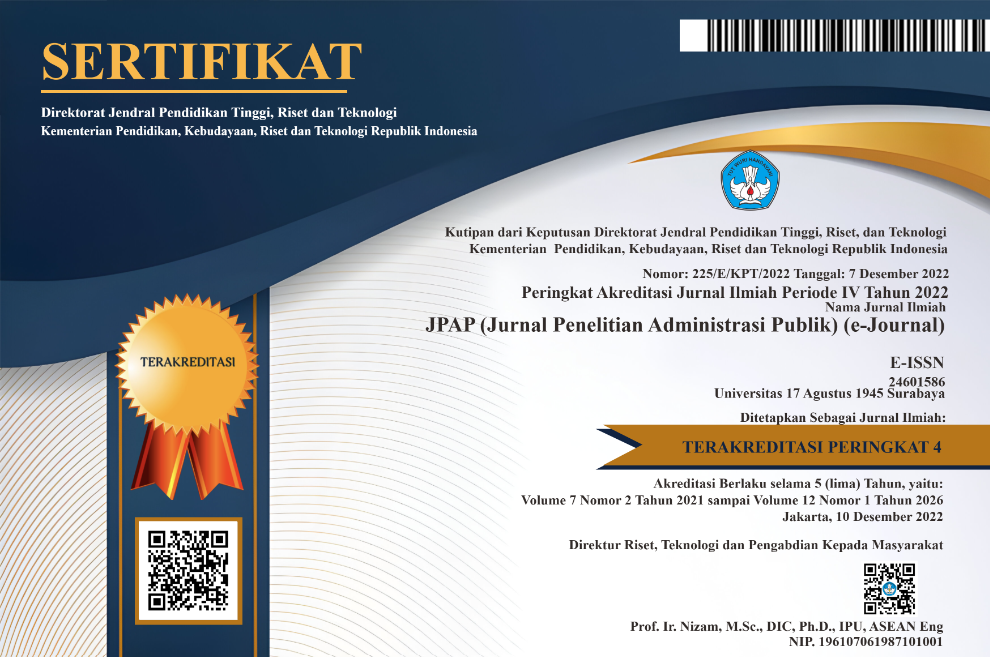
Accreditation
Citedness in Scoppus

KERJASAMA


INFORMATION
VISITORS
 StatCounter
Published by:
Program Studi Ilmu Administrasi Negara, Fakultas Ilmu Sosial dan Ilmu Politik, Universitas 17 Agustus 1945 Surabaya
Jl. Semolowaru 45 Surabaya Jawa Timur 60118 Indonesia

This work is licensed under a Creative Commons Attribution-ShareAlike 4.0 International License View My Stats
