ADDITIONAL MENU

JPAP: Jurnal Penelitian Administrasi Publik is committed to maintaining the integrity, accuracy, and reliability of the scholarly record. When errors or research integrity concerns are identified, the Journal will assess the available evidence and take appropriate action with reference to relevant Committee on Publication Ethics (COPE) guidance.
This policy distinguishes the withdrawal of an unpublished manuscript from corrections, expressions of concern, and retractions affecting published articles. Its purpose is to protect readers and maintain an accurate scholarly record, rather than to punish authors.
JPAP may publish a Correction when an error or omission can be addressed without undermining the overall reliability of an article.
Corrections may address errors in data presentation, calculations, descriptions of methods, author details, contributor statements, funding information, competing interest declarations, or other substantive information.
Authorship changes must also comply with JPAP’s Authorship Criteria, including the applicable requirements for supporting explanations and author agreement.
A correction notice will identify the affected article, describe the error and the amendment, and be linked to the original publication. Where the article itself is updated, the change and its date will be clearly indicated. Substantive changes will not be made through silent replacement of the published content.
Minor typographical or formatting errors that do not affect meaning, attribution, or interpretation may be corrected without a separate formal notice, with an appropriate record of the change maintained by the Journal.
JPAP may issue an Expression of Concern when serious questions about an article’s integrity or reliability require readers’ attention, but the available evidence does not yet support a definitive conclusion.
Circumstances may include:
An investigation is ongoing and a conclusion is not expected promptly;
Available evidence is substantial but inconclusive;
Relevant institutions are unable or unwilling to investigate concerns adequately; or
There are reasonable doubts about the fairness or conclusiveness of an investigation.
An Expression of Concern is an interim editorial notice and does not establish that misconduct has occurred.
The notice will explain the nature of the concern without making unsupported allegations. When sufficient information becomes available, JPAP will publish an appropriate update, correction, retraction, or notice explaining that the concern has been resolved.
JPAP may retract an article when there is clear evidence that:
Its findings are unreliable because of serious error, fabrication, falsification, or misleading manipulation of research materials;
It contains plagiarism;
It substantially duplicates previously published work without appropriate acknowledgment, disclosure, permission, or justification;
It includes materials or data used without authorization, or presents a serious copyright or other legal concern;
It reports unethical research;
Its publication was based on a substantially compromised or manipulated peer-review process; or
A major undisclosed competing interest materially affected the interpretation of the work or its editorial assessment.
Retraction may be necessary whether the problem results from misconduct or honest error. A correction will be preferred when it can adequately resolve the problem and the article remains reliable.
An authorship dispute alone will not normally justify retraction when there is no reason to question the validity of the findings. Scholarly disagreement or an author’s wish to publish the work elsewhere is not, by itself, a sufficient basis for retraction.
Retraction may be requested by authors or initiated by the Editorial Team following concerns raised by readers, reviewers, institutions, or other parties. The final editorial decision rests with the Editor-in-Chief or an appropriately designated independent editor.
Authors will normally be given an opportunity to respond. However, a retraction may proceed without the agreement of some or all authors when the evidence warrants it.
Retraction notices will:
Clearly identify the article, including its title, authors, and DOI;
State who is retracting the article;
Explain the reasons and evidential basis for the decision;
Distinguish established facts from unresolved allegations;
Use objective and professional language; and
Be freely accessible and permanently linked to the affected article.
Retracted articles will normally remain available as part of the scholarly record. Their webpages and downloadable versions will be clearly marked “Retracted.”
Authors should submit manuscripts only when they intend to complete the publication process. Nevertheless, JPAP recognizes that withdrawal before publication may be appropriate in certain circumstances.
Reasons may include the discovery of a serious error, unresolved authorship or consent issues, ethical concerns, or substantial editorial delays.
The corresponding author must submit a written request to the Editor-in-Chief identifying the manuscript and explaining the reasons for withdrawal.
The request must include written confirmation from all authors, through signatures or verifiable individual email confirmations. If agreement cannot be obtained, the corresponding author must explain the circumstances so that the Journal can assess the matter.
The Editorial Team will acknowledge the request and communicate its status promptly. Authors should obtain written confirmation that editorial consideration has ended before submitting the manuscript elsewhere. A withdrawal request must not be used to conceal simultaneous submission or redundant publication.
If a manuscript has remained under review for more than six months, authors may request withdrawal on the grounds of delay. JPAP will process such requests promptly and without a withdrawal penalty.
Withdrawal does not prevent the Journal from examining serious integrity concerns or referring them to an appropriate institution.
An article that has already been published online as the final version of record cannot be treated as an unpublished manuscript. Requests concerning such articles will be assessed under the correction, expression of concern, or retraction provisions of this policy.
This also applies to final articles published within an issue designated “In Progress.”
Removal of published content is distinct from retraction and will be considered only in exceptional circumstances, such as a serious violation of privacy, clearly defamatory content, a binding legal requirement, or a serious risk of harm.
Where removal is necessary, JPAP will retain the bibliographic record and publish a notice explaining the reason to the extent permissible. The Journal will consider whether a limited redaction can adequately address the concern before removing the full text.
An article will not be removed solely because an author disagrees with criticism, wishes to publish elsewhere, or seeks to avoid a retraction notice.
Concerns should be submitted through the Journal’s official contact channel and, where possible, include the article title, DOI, a clear explanation, and supporting evidence.
JPAP will:
Assess the concern and request clarification where necessary;
Provide relevant parties with a reasonable opportunity to respond;
Seek independent expert assessment or institutional cooperation where appropriate;
Determine the appropriate editorial action based on the available evidence; and
Communicate and document the outcome while respecting confidentiality.
Editors with relevant conflicts of interest will not handle the case. Concerns involving the Editor-in-Chief will be referred to the publisher for independent handling.
The Journal may act to correct unreliable findings without waiting for a formal institutional determination of misconduct when the available evidence is sufficient.
JPAP will not impose a penalty for requesting manuscript withdrawal or charge authors for issuing a Correction, Expression of Concern, or Retraction.
Payment, non-payment, or a financial dispute must not determine whether an editorial notice is issued or delay an action necessary to protect the scholarly record.
Any applicable publication fees and refund arrangements are governed separately by the Journal’s published fee policy.
Corrections, Expressions of Concern, and Retractions will be clearly labeled, dated, freely accessible, and linked to the affected article.
JPAP will maintain accurate article metadata and, where supported by the relevant systems, communicate changes in publication status to DOI registration services and indexing platforms.
The original publication date and the history of substantive amendments will remain identifiable.
Authors or other directly affected parties may request reconsideration by presenting new evidence or identifying a substantive factual or procedural error.
Where practicable, the request will be assessed by an uninvolved editor or publisher representative without a relevant conflict of interest. Reconsideration will not automatically suspend a notice needed to inform or protect readers.
This policy should be read alongside JPAP’s:
Publication Ethics Statement
Research and Publication Misconduct Policy
Post-Publication Discussion and Critique Policy
Authorship Criteria
Declaration of Conflicting Interests Policy
Publication Schedule Policy
JPAP refers to the COPE Retraction Guidelines and other relevant COPE guidance when determining appropriate action. This policy will be reviewed periodically to maintain consistency with the Journal’s practices and developments in publication ethics.
JOURNAL TEMPLATE

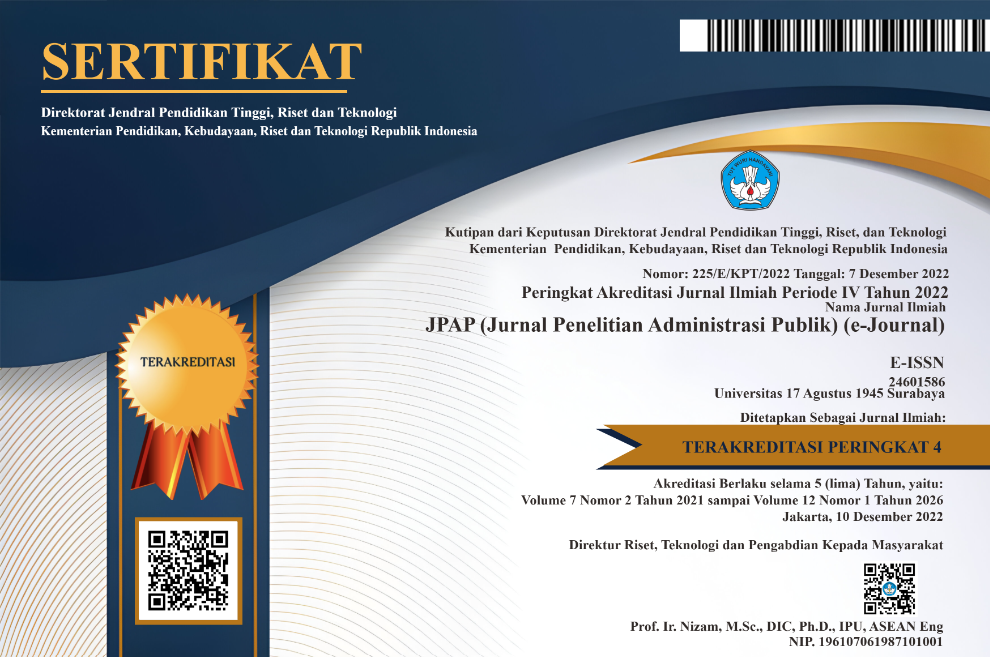
Accreditation
Citedness in Scoppus

KERJASAMA


INFORMATION
VISITORS
 StatCounter
Published by:
Program Studi Ilmu Administrasi Negara, Fakultas Ilmu Sosial dan Ilmu Politik, Universitas 17 Agustus 1945 Surabaya
Jl. Semolowaru 45 Surabaya Jawa Timur 60118 Indonesia

This work is licensed under a Creative Commons Attribution-ShareAlike 4.0 International License View My Stats
