ADDITIONAL MENU

JPAP: Jurnal Penelitian Administrasi Publik is committed to transparency, integrity, and accountability in research and scholarly publishing. Guided by the relevant principles and guidance of the Committee on Publication Ethics (COPE), this policy establishes requirements for disclosing and managing conflicting interests throughout the publication process.
This policy applies to authors, reviewers, editors, and editorial board members. It covers manuscripts under consideration and articles published in JPAP.
A conflicting interest, also referred to as a competing interest or conflict of interest, exists when a financial, personal, professional, institutional, or other relationship could influence—or reasonably be perceived to influence—a person’s judgment concerning the research, peer review, or editorial decision-making.
The existence of a conflicting interest does not necessarily imply misconduct or invalidate the research. Disclosure enables the Journal and its readers to assess relevant relationships transparently and allows appropriate measures to protect editorial independence.
All authors must disclose relevant interests when submitting a manuscript. Disclosures must cover relationships connected to the conduct of the research and the preparation, assessment, or publication of the article, including relevant past relationships and reasonably anticipated interests.
The corresponding author must ensure that every co-author has reviewed and confirmed the declaration. Each author remains responsible for the accuracy and completeness of their own disclosure.
Authors must promptly notify the Editorial Team of any relevant interest that arises or becomes known during review, after acceptance, or after publication. If uncertain whether an interest is relevant, authors should disclose it to the editor for assessment.
Authors must disclose relevant financial relationships, including:
Employment, paid consultancy, advisory work, or contractual relationships;
Research grants, sponsorship, honoraria, or payments for speaking or training;
Ownership interests, shares, patents, royalties, or other financial benefits; and
Financial or in-kind support from organizations that may benefit from, or be affected by, the findings.
Authors must disclose relevant non-financial interests, including personal relationships, professional rivalries, leadership positions, advocacy roles, or other commitments that could reasonably affect the interpretation or presentation of the research.
Disclosure should focus on interests relevant to the manuscript. Authors are not required to disclose unrelated private beliefs or personal information.
Given the scope of JPAP, authors must disclose relevant relationships with government agencies, public institutions, political organizations, civil society organizations, private contractors, or other bodies connected to the research.
Examples include:
Evaluating a policy or program that the author helped design, implement, administer, or supervise;
Conducting research on an institution where the author is employed or holds a decision-making role;
Receiving funding or consultancy payments from an organization whose performance is assessed; and
Holding an advisory, political, or advocacy role directly related to the policy issue examined.
An institutional affiliation listed in the manuscript does not replace a specific disclosure explaining a relevant relationship.
Authors must disclose all sources of financial and material support in a separate Funding statement, including grant identifiers where applicable.
Authors must describe any role of the funder or sponsor in the study design, data collection, analysis, interpretation, manuscript preparation, or decision to submit the article. Relevant restrictions on access to data or publication must also be disclosed.
Funding does not automatically constitute a conflicting interest. However, relationships that could influence the research must also be explained in the Declaration of Conflicting Interests statement.
Editors and reviewers must disclose relevant interests before accepting an assignment and promptly report any that become apparent later.
Reviewers must decline assignments where relationships could compromise impartiality, including employment at the same institution as an author, recent close collaboration or supervisory relationships, significant personal relationships, or direct financial interests in the research.
Editors with relevant conflicting interests must withdraw from the assessment and decision-making process. The manuscript will be assigned to an editor without the relevant conflict. Where necessary, JPAP will appoint an independent reviewer or seek independent editorial oversight.
If a reviewer identifies a potential conflict during double-blind review, they must notify the handling editor without attempting to investigate or disclose the authors’ identities.
Manuscripts submitted by JPAP editors or editorial board members are subject to the Journal’s usual editorial standards and peer-review requirements.
The submitting editor or board member must not select reviewers, manage the review, or participate in the editorial decision concerning their manuscript. Their role at the Journal must be disclosed, and an independent editor will oversee the submission.
Where the Editor-in-Chief has a conflicting interest, responsibility will be transferred to an uninvolved editor or, where necessary, an independent editor designated by the publisher.
Editors and reviewers must protect the confidentiality of manuscripts, supporting materials, and editorial correspondence. Unpublished information must not be used for personal, professional, financial, or institutional advantage or shared without appropriate authorization.
Every published article must include a section titled Declaration of Conflicting Interests. The statement must accurately reflect the circumstances of all authors and identify individual authors where their interests differ.
For double-blind review, identifying disclosures should be provided in the separate title page or submission materials available to the editor. The complete declaration must be included in the final published article.
The examples below are templates and must be adapted to the authors’ actual circumstances.
Declaration of Conflicting Interests
The authors declare no financial or non-financial competing interests relevant to the research, authorship, or publication of this article.
Declaration of Conflicting Interests
[Author’s name] is employed by [institution], whose [policy/program/service] is examined in this study. This relationship is disclosed as a potential competing interest. The remaining authors declare no competing interests relevant to this article.
Declaration of Conflicting Interests
[Author 1’s name] received consultancy fees from [organization] for work related to [relevant activity]. [Author 2’s name] participated in the design or implementation of [policy/program] examined in this study. [Author 3’s name] declares no competing interests relevant to this article.
Declaration of Conflicting Interests
[Author’s name] serves as [editorial position] at JPAP: Jurnal Penelitian Administrasi Publik. This author had no involvement in the peer-review management or editorial decision concerning this manuscript. The submission was handled by an independent editor. The remaining authors declare no competing interests relevant to this article.
The description of independent handling must be confirmed by the Journal before publication.
The Editorial Team will assess disclosed interests and determine whether additional clarification or safeguards are needed. Measures may include expanded disclosure, reassignment of editors or reviewers, independent assessment, or a request for further information about the funder’s role.
Disclosure alone is not a reason for rejection. Editorial decisions will consider the manuscript’s scholarly quality, the nature of the interest, and whether any resulting risks to research or editorial integrity can be adequately managed.
If a potentially undisclosed interest is identified, JPAP will seek clarification from the relevant person(s) and assess the available evidence fairly.
Before publication, the Journal may require an amended declaration, arrange independent review, or pause the editorial process while the concern is examined.
After publication, JPAP may publish a correction to disclose the relevant interest. Where substantial concerns remain unresolved or the integrity of the article or review process is seriously compromised, further action may be taken under the Journal’s Research and Publication Misconduct Policy and relevant COPE guidance.
Failure to disclose an interest does not automatically warrant retraction. Any action will be proportionate to the evidence and its implications for the published record.
Concerns about undisclosed conflicting interests may be submitted to the Editor-in-Chief through the official contact channel on the Journal’s website. Reports concerning the Editor-in-Chief should be directed to the publisher for independent handling.
This policy should be read alongside JPAP’s Research and Publication Misconduct Policy and Post-Publication Discussion and Critique Policy. It will be reviewed periodically to maintain alignment with developments in publication ethics.
JOURNAL TEMPLATE

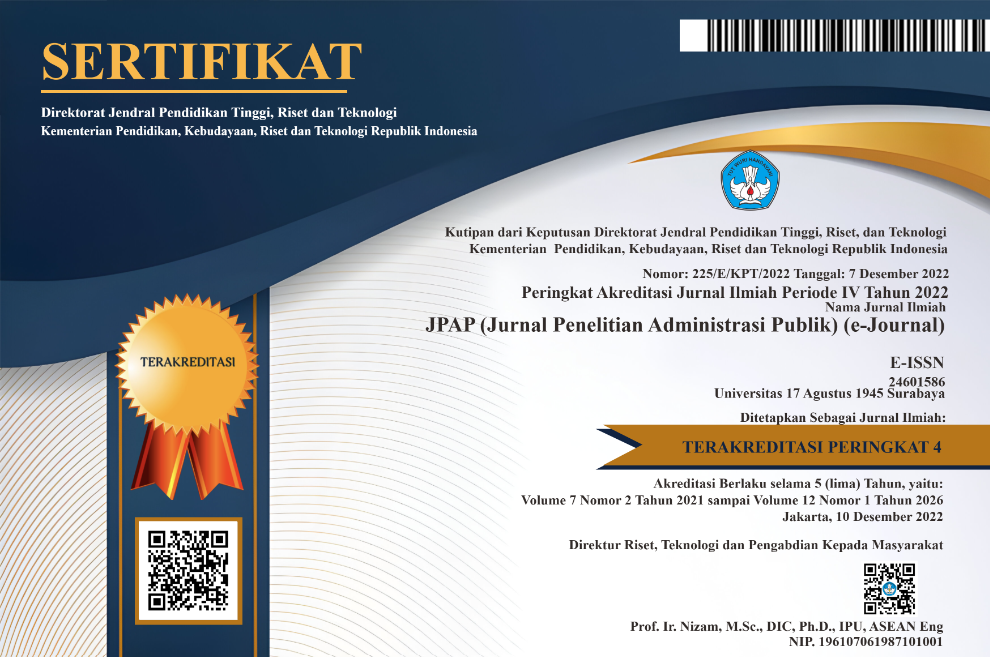
Accreditation
Citedness in Scoppus

KERJASAMA


INFORMATION
VISITORS
 StatCounter
Published by:
Program Studi Ilmu Administrasi Negara, Fakultas Ilmu Sosial dan Ilmu Politik, Universitas 17 Agustus 1945 Surabaya
Jl. Semolowaru 45 Surabaya Jawa Timur 60118 Indonesia

This work is licensed under a Creative Commons Attribution-ShareAlike 4.0 International License View My Stats
