ADDITIONAL MENU

JPAP: Jurnal Penelitian Administrasi Publik is committed to upholding research integrity, publication ethics, and the reliability of the scholarly record. JPAP is guided by the ethical principles, Core Practices, and relevant guidance of the Committee on Publication Ethics (COPE).
This policy establishes a framework for preventing, identifying, and addressing allegations of research and publication misconduct in a fair, objective, consistent, and appropriately transparent manner. It applies to authors, reviewers, editors, and other parties involved in the Journal’s publication process and covers both manuscripts under consideration and published articles.
Research and publication misconduct may include, but is not limited to, the following:
Plagiarism
Presenting another person’s ideas, words, data, images, or other work without appropriate attribution is unacceptable. Authors must accurately acknowledge all sources, including previously published materials and relevant unpublished contributions.
Fabrication and Falsification of Data
Fabrication involves inventing data, findings, or research activities that did not occur, including fictitious survey responses, interviews, observations, or documentary evidence. Falsification involves manipulating, altering, selectively omitting, or misrepresenting research materials, procedures, data, or results in a manner that misleads readers.
Citation Manipulation
Citations must be relevant and accurately represent the sources cited. Practices intended improperly to increase citation counts or publication metrics—including coercive citation requests, irrelevant self-citation, or coordinated citation arrangements—are prohibited.
Duplicate or Redundant Publication
Authors must not submit the same manuscript simultaneously to more than one journal or publish substantially overlapping work without appropriate disclosure, justification, and acknowledgment. Any related publications or manuscripts that may overlap with a submission must be disclosed to the Editorial Team.
Salami Slicing
Dividing a single study into multiple substantially overlapping publications without adequate scholarly justification is unacceptable. Publications drawing on the same dataset must make distinct scholarly contributions and transparently acknowledge related work.
Authorship Misconduct
Authorship must accurately reflect qualifying scholarly contributions and responsibility for the work. Guest authorship, gift authorship, ghost authorship, omission of eligible authors, and inclusion of individuals without their knowledge and consent are unacceptable. Contributions that do not qualify for authorship should be appropriately acknowledged.
Undisclosed Conflicts of Interest
Authors, reviewers, and editors must disclose relevant financial, professional, institutional, personal, or other competing interests that could reasonably influence—or be perceived to influence—the research, peer review, or editorial decision-making.
Peer-Review Manipulation
Attempts to improperly influence peer review are prohibited. These include fabricated reviewer identities, fraudulent reviewer accounts, undisclosed review collusion, and inappropriate interference with independent editorial decisions.
Image or Research Material Manipulation
Altering images, tables, visualizations, transcripts, documents, or other research materials in ways that misrepresent the evidence or findings is unacceptable. Legitimate processing or editing must preserve the meaning of the original material and be disclosed where relevant.
Violations of Research Ethics
Research involving human participants, including surveys, interviews, focus groups, and observations, must meet applicable ethical requirements. Relevant concerns include failure to obtain ethics approval or an appropriate exemption where required, failure to obtain informed consent where applicable, inadequate protection of confidential information, and misrepresentation of ethical approval or consent procedures. Particular care must be taken when research involves vulnerable participants or sensitive personal, organizational, or political information.
Other Forms of Misconduct
JPAP may address other conduct that undermines research integrity or the publication process, including misuse of confidential manuscripts, unauthorized use of research materials, and deliberate misrepresentation of research provenance or contributions.
Honest errors and legitimate scholarly disagreements do not, by themselves, constitute misconduct. Nevertheless, errors that affect the accuracy or reliability of the scholarly record may require editorial action.
Any reader, author, reviewer, editor, or other concerned party may report suspected misconduct involving a manuscript under consideration or an article published in JPAP.
Reports should be submitted to the Editor-in-Chief through the official contact channel listed on the Journal’s website. Where possible, a report should include:
The title, DOI, manuscript identification number, or other identifying details of the work concerned;
A clear description of the alleged misconduct;
Relevant supporting evidence, references, or documents;
Any relevant conflicts of interest; and
Contact details for follow-up correspondence, where the reporting party is willing to provide them.
Reports will be assessed on their substance and supporting evidence. Anonymous reports or reports submitted under a pseudonym may be considered when they contain sufficiently specific and verifiable information. A reporting party’s identity or perceived motivation will not, by itself, determine whether a substantive concern is examined.
JPAP will handle reports discreetly and protect the identity of reporting parties as far as reasonably possible. Absolute confidentiality cannot be guaranteed where disclosure is necessary for a fair assessment or required by applicable obligations. Information will be shared only with parties who need it to assess or resolve the concern.
The Editor-in-Chief or a designated editor will assess whether the report contains sufficient information to warrant further examination. Additional evidence or clarification may be requested from the reporting party, the author(s), or other relevant parties.
Where appropriate, JPAP may consult independent experts. Similarity reports, screening results, or other automated indicators will be considered alongside contextual evidence and will not, on their own, establish misconduct.
Any editor or reviewer with a relevant conflict of interest must withdraw from handling the case. Allegations involving an editor will be assigned to an uninvolved editor or, where necessary, referred to the publisher for independent handling.
If an allegation concerns the Editor-in-Chief, it should be directed to the publisher through its official contact channel. The Editor-in-Chief will not oversee the assessment of allegations concerning their own conduct.
The person(s) concerned will be informed of the substantive concerns and given a reasonable opportunity to provide an explanation and supporting evidence within a specified timeframe.
JPAP will not conclude that misconduct has occurred solely on the basis of an allegation, suspicion, or failure to respond. However, the Journal may make editorial decisions on the available evidence if a response is not received after reasonable efforts to obtain one.
For concerns involving a submitted manuscript, JPAP may pause the editorial process and request relevant supporting materials, such as anonymized research data, methodological explanations, ethics documentation, or records supporting the reported findings.
Requests for supporting materials will take account of participant confidentiality, consent restrictions, and legitimate data-access limitations.
If concerns remain unresolved or there are substantial grounds to suspect misconduct, JPAP may contact the author’s institution or another appropriate research-governance body. Rejection or withdrawal of a manuscript does not necessarily end the examination of a serious integrity concern.
For concerns involving a published article, JPAP may seek explanations from the author(s), consult independent experts, and contact relevant institutions or research-governance bodies.
The appropriate editorial response will depend on the nature of the concern and the available evidence:
Correction: When an identifiable error can be corrected without invalidating the article’s overall findings or conclusions.
Expression of Concern: When serious concerns remain unresolved, evidence is inconclusive, or an investigation is ongoing and readers need to be alerted.
Retraction: When clear evidence demonstrates that the findings are unreliable, whether because of serious error, fabrication, or falsification, or when other grounds specified in relevant COPE guidance apply, such as plagiarism, unethical research, or a compromised peer-review process.
A retraction serves to correct the scholarly record and does not, by itself, establish that every author committed misconduct. An authorship dispute alone will not normally justify retraction where the reliability of the findings is unaffected.
JPAP is responsible for editorial decisions and the integrity of its published record. Formal investigations into researchers’ conduct generally fall within the responsibility of their institutions or other authorized bodies.
JPAP may cooperate with these bodies and consider their findings while retaining responsibility for its own editorial actions. Action to protect readers or correct unreliable findings need not depend on a formal finding of misconduct.
JPAP will maintain appropriate records of the concern, correspondence, evidence considered, and decisions taken. Outcomes may be communicated to relevant parties, subject to confidentiality and applicable data-protection requirements.
Cases will be handled as promptly as reasonably possible. The time required may vary according to their complexity and the involvement of external institutions.
Depending on the nature, seriousness, and outcome of the case, JPAP may:
Request clarification, supporting documentation, or corrections;
Require manuscript revision;
Pause or terminate the editorial process;
Reject a manuscript;
Publish a Correction;
Publish an Expression of Concern;
Publish a Retraction;
Contact relevant institutions, research organizations, funders, or research-governance bodies;
Remove an editor or reviewer from handling the affected manuscript or case; or
Take other proportionate action consistent with relevant COPE guidance.
Decisions will be based on the available evidence and the need to protect the integrity of the scholarly record.
Published notices will clearly identify the affected article, explain the reasons for the action, and be linked to the article. Retracted articles will normally remain accessible and be clearly marked as retracted.
A person directly affected by an editorial decision under this policy may request reconsideration by providing new evidence or identifying a substantive factual or procedural error.
Requests should be submitted through the Journal’s official contact channel. Where practicable, reconsideration will be handled by an editor or publisher representative who was not involved in the original decision and has no relevant conflict of interest. Repeated requests that provide no new evidence or substantive grounds may be declined.
Authors are responsible for the accuracy and integrity of their submissions, appropriate attribution, transparent reporting, and cooperation in resolving concerns.
Reviewers and editors must maintain confidentiality, disclose relevant conflicts of interest, assess manuscripts fairly, and report suspected ethical concerns through appropriate channels.
Readers and other members of the scholarly community are encouraged to raise concerns responsibly and provide evidence that can assist editorial assessment.
JPAP will review this policy periodically and update it as necessary to reflect developments in research integrity and publication ethics.
JPAP handles allegations with reference to relevant COPE Core Practices, flowcharts, and guidelines, including guidance on suspected fabricated data in submitted manuscripts and published articles, retractions, and cooperation between journals and research institutions.
This policy should be read alongside JPAP’s Post-Publication Discussion and Critique Policy and other applicable editorial policies.
Reporting Allegations of Misconduct:
Reports should be addressed to the Editor-in-Chief of JPAP: Jurnal Penelitian Administrasi Publik through the official contact channel provided on the Journal’s website. Reports concerning the Editor-in-Chief should be directed to the publisher.
JOURNAL TEMPLATE

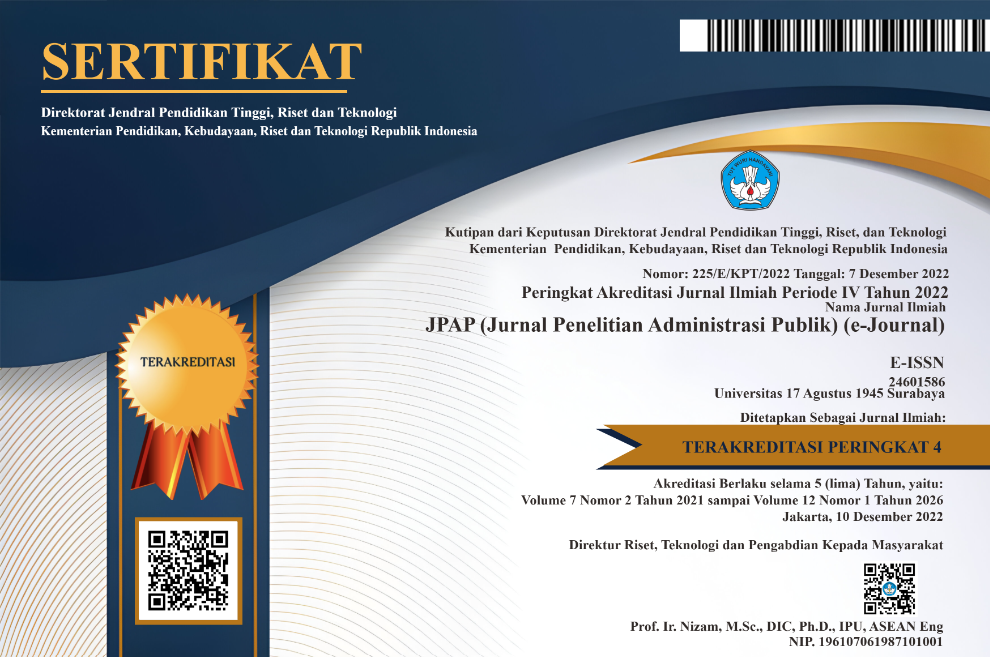
Accreditation
Citedness in Scoppus

KERJASAMA


INFORMATION
VISITORS
 StatCounter
Published by:
Program Studi Ilmu Administrasi Negara, Fakultas Ilmu Sosial dan Ilmu Politik, Universitas 17 Agustus 1945 Surabaya
Jl. Semolowaru 45 Surabaya Jawa Timur 60118 Indonesia

This work is licensed under a Creative Commons Attribution-ShareAlike 4.0 International License View My Stats
