ADDITIONAL MENU

JPAP: Jurnal Penelitian Administrasi Publik is committed to maintaining the integrity, transparency, and reliability of the scholarly record. Guided by the relevant principles of the Committee on Publication Ethics (COPE), JPAP welcomes constructive post-publication discussions concerning articles published in the Journal. Readers and members of the scholarly community may submit critiques, comments, requests for clarification, or new information relevant to published articles.
A post-publication critique is a formal scholarly communication concerning a published article. It may be considered for publication as a Letter to the Editor, Commentary, Comment, Correspondence, or another appropriate format determined by the Editorial Team.
Critiques must be relevant, constructive, evidence-based, and professionally presented. They should address the scholarly content of the article, including its theoretical arguments, methodology, analysis, interpretation, or conclusions. Alternative interpretations and reasoned disagreements are welcome; personal attacks and unsupported allegations are not acceptable.
Critiques should be submitted to the Editorial Team through the contact channel provided on the Journal’s website. Submissions should identify the article concerned, preferably by its title and DOI, clearly explain the issues raised, and include supporting evidence or references. Contributors must provide their contact details and disclose any relevant conflicts of interest.
Each critique will undergo an editorial assessment to determine its relevance, scholarly merit, and suitability for publication. JPAP may request additional evidence or clarification and, where necessary, seek assessment from reviewers or independent experts. Editors and reviewers with relevant conflicts of interest will not participate in the assessment or decision-making process.
When a critique is considered suitable for publication, JPAP will provide the original author(s) with an opportunity to submit a response or reply within a timeframe specified by the Editorial Team.
Responses should address the substantive issues raised and maintain a professional, evidence-based tone. Both critiques and responses may undergo peer review and revision before an editorial decision is made.
If the original author(s) do not respond within the specified period, JPAP may still publish the critique if it meets the Journal’s scholarly and editorial standards. Failure to respond does not constitute an admission that the critique is correct.
Published critiques and responses will clearly identify the original article and, wherever technically feasible, be linked to it to enable readers to follow the discussion.
If a critique identifies an error or raises concerns about a published article, JPAP will assess the available evidence and determine the appropriate action in accordance with relevant COPE guidance.
Correction: A correction may be issued when an error affects part of an article but does not invalidate its overall findings or conclusions.
Expression of Concern: An expression of concern may be issued when serious concerns remain unresolved, the available evidence is inconclusive, or an investigation is ongoing and readers need to be informed.
Retraction: An article may be retracted when clear evidence demonstrates that its findings are unreliable or when other grounds for retraction under relevant COPE guidance are established.
Differences in scholarly interpretation or opinion alone do not constitute grounds for correction or retraction.
Concerns involving possible research or publication misconduct will be handled through the Journal’s procedures for addressing ethical concerns, with reference to relevant COPE guidance. Where appropriate, JPAP may seek clarification from the author(s), their institution(s), or other relevant bodies.
Any correction, expression of concern, or retraction notice will clearly state the reason for the action and be linked to the original article. Retracted articles will normally remain accessible as part of the scholarly record, with their retracted status clearly indicated.
JPAP may close a discussion when the substantive issues have been adequately addressed, no new evidence or arguments are provided, or further correspondence no longer makes a meaningful scholarly contribution. However, new material evidence concerning the integrity or reliability of a published article may be considered at any time.
This policy is guided by COPE’s Core Practices on post-publication discussions and corrections and its guidance on handling post-publication critiques and retractions.
JOURNAL TEMPLATE

Accreditation
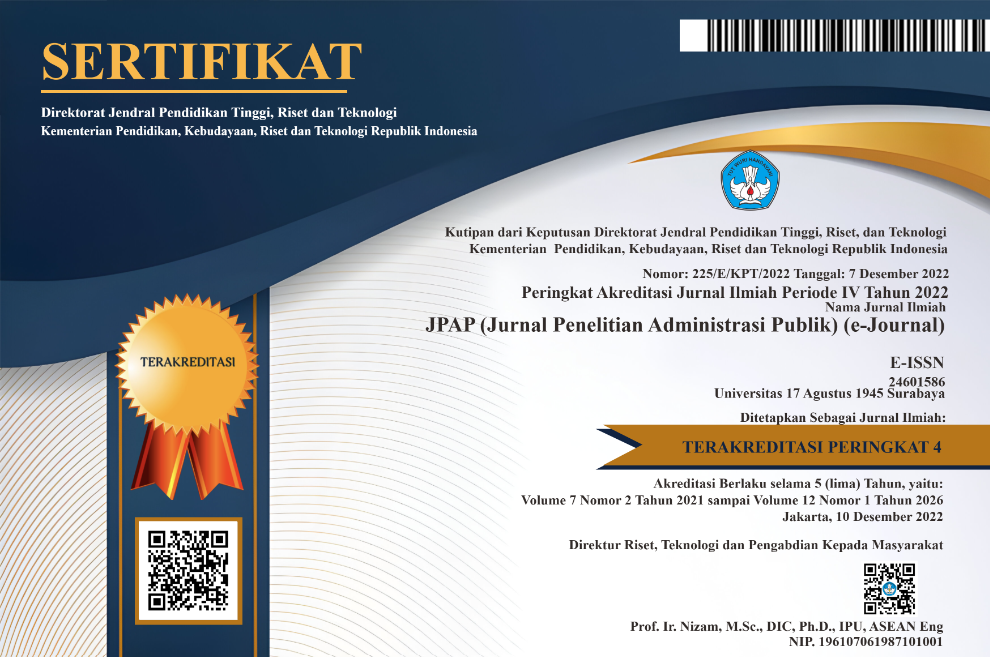
Citedness in Scoppus

KERJASAMA


INFORMATION
VISITORS
 StatCounter
Published by:
Program Studi Ilmu Administrasi Negara, Fakultas Ilmu Sosial dan Ilmu Politik, Universitas 17 Agustus 1945 Surabaya
Jl. Semolowaru 45 Surabaya Jawa Timur 60118 Indonesia

This work is licensed under a Creative Commons Attribution-ShareAlike 4.0 International License View My Stats
