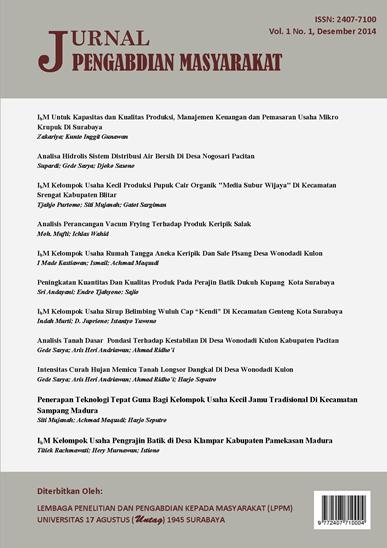
Peningkatan Kuantitas dan Kualitas Produk pada Perajin Batik Dukuh Kupang Kota Surabaya
DOI:
https://doi.org/10.30996/jpm17.v1i01.352Abstract
Abstract. The decision moment of batik as world cultural heritage from Indonesia is used maximally by batik craftsmen in the whole Nusantara, unexceptionally batik craftsmen in Surabaya. Surabaya nowadays has had several Batik kampungs in the planning to develop and conserve Surabaya City uniqueness. Prima Amri Surahmat and Suprapti, two batik craftsmen who live at Dukuh Kupang Surabaya area, are partners in the program of IbM 12 persons batik craftsmen group members. Problems of batik making process is too long (not efficient in time) because it must make design /batik motif on paper (Blat) and is moved to cloth one by one, using batik color material from chemical material, makes craftsmen uncomfortable because it is dangerous for health and the sewage can destroy environment. Very traditional entrepreneur management which has no accountancy/entrepreneur noting even though in simple one. The lack of horizon about Marketing Strategy. Execution Method: Methods of training and accompaniment Learning By Doing, and Participative Method. Target and Output :1.Availability of Batik Design Print table to facilitate batik craftsmen in making batik design 2Supplying of Natural Color Matter with raw material from nature.3.Availability of Stainless Steel pan for mordanting process, and Stove and Tube of LPG Gas 4. Increasing of batik tulis production output with natural color. 5.Increasing of entrepreneur management and marketing strategy capabilities, availability of orderly accountancy and entrepreneur activity noting. 6.Availability of Promotion Media in the forms of Brochure and Banner. The achieved output is fit with target and Scientific Bulletin.
Keywords: Batik design table, natural color matter, lorot dye tools.
Downloads
References
Anderson, James E. (1979). Public Policy Making. Second Edition, New York.
Amirullah dan Hanafi Rindyah. (2002). Pengantar Manajemen. Yogyakarta: Graha Ilmu.
Bellen, S., dkk, (2000). Manajemen Berbasis Sekolah. Jakarta: UNESCO-UNICEF-Pemerintah Indonesia.
Bush, Tony. (1986). Theories of Educational Management. London: Paul Chapman Publishing.
Bungin, Burhan. (2003). Analisis Data Pene-litian Kualitatif. Jakarta: RajaGrafindo Persada.
Carlisle, Howard M. (1987). Management Essentials, Concepts for Productivity and Innovation. Chicago: Science Reseacrh Associates.
Denzin, Norman K., & Yvonna S. Lincoln (ed). (1998). Strategies of Qualitative Inquiry. New Delhi: Sage Publications.
Dinas Pendidikan Kalimantan Selatan. (2002). Panduan Implementasi Berbasis Sekolah Di Kalimantan Selatan.
Dye, Thomas R. (1978). Understanding Public Policy. Englewood Cliffs, N.J.: Prentice Hall.
Duhou, Ibtisam Abu. (1999). School-Based Management. UNESCO, Paris.
Dunn, William N. (2003). Pengantar Analisis Kebijakan Publik. Yogyakarta: Gajah Mada Univenity Press.
Etzioni, Amitai. (1996). The New Golden Rule. New York: Basic Books.
Easton, Joseph W. (ed). (1988). Institutional Building and Development: From Concepts to Aplications. (terjemahan). Jakarta: UI Press.
Edward III, George C. (1980). Implementing Public Policy. Washington: Congresional Quarterly Press.
Gibson, Donnely, and Ivancevic. (1996). Manajemen (terjemahan). Jakarta: Erla-ngga.
Grindle, Merilee S. (1980). Politics and Policy Implementation In The Third World. New Jersey: Princeton University Press.
Hatry, Harry P. et.al. (1994). Implementing School-Based Management, Insight Into Decentralization from Science and Mathe-matics Departement. Washington: The Urban Institute.
Islamy, Irfan M. (2002). Prinsip-Prinsip Peru-musan Kebijaksanaan Negara. Jakarta: Bumi Aksara.
Indrawijaya, Adam I. (1989). Perilaku Orga-nisasi. Bandung: Sinar Baru.
Jones, Charles O. (1984). An Introduction to the Study of Public Policy. North Institute Massachussets : Dux bury Press, Califor-nia.
Kane, Eileen (1985). Doing Your Own Rese-arch. London: Marion Boyars.
Lasswell, H.D. dan Kaplan A. (1970). Power and Society. New Haven: Yale University Press.
Moleong Lexy J. (2000). Metodologi Peneliti-an Kualitatif. Jakarta: Remaja Rosdakarya.
Muhadjir, Noeng H. (1998). Metodologi Pene-litian Kualitatf. Jakarta: Rakesarasin.
Muslim, Faesol, dkk. (2000). Peran Serta Masyarakat dalam Pendidikan. Jakarta: UNESCO-UNICEF-Pemerintah Indonesia.
Neuman, Lawrence W. (2000). Social Rese-arch Methods: Qualitative and Quatitative Approaches. Fourth edition. Boston: Allyn and Bacon.
Priatmoko, Dody Heriawan. (2003). Reforma-si Pendidikan Indonesia, Suatu Solusi Keluar dari Krisis. Makalah dalam Website Balitbang Depdiknas. Jakarta.
Putra, Fadillah. (2003). Partai Politik dan Kebijakan Publik. Yogyakarta: Pustaka Pelajar.
Rahim, Husni. (2003). RUU Sisdiknas dan Reformasi Pendidikan Indonesia. (Maka-lah). Jakarta: UIN Syarif Hidayatullah.
Rosyada, Dede (2004). Paradigma Pendidikan Demokratis, Sebuah Model Pelibatan Ma-syarakat Dalam Penyelenggaraan Pendi-dikan. Jakarta: Kencana.
Downloads
Published
Issue
Section
License
COPYRIGHT NOTICE
The copyright in this website and the material on this website (including without limitation the text, computer code, artwork, photographs, images, music, audio material, video material and audio-visual material on this website) is owned by PM17: Jurnal Pengabdian Masyarakat and its licensors.
Copyright license
JPM17: Jurnal Pengabdian Masyarakat grants to you a worldwide non-exclusive royalty-free revocable license to:
- View this website and the material on this website on a computer or mobile device via a web browser;
- Copy and store this website and the material on this website in your web browser cache memory; and
- Print pages from this website for your
- All articles published by PM17: Jurnal Pengabdian Masyarakat are licensed under the creative commons attribution 4.0 international license. This permits anyone to copy, redistribute, remix, transmit and adapt the work provided the original work and source is appropriately cited.
JPM17: Jurnal Pengabdian Masyarakat does not grant you any other rights in relation to this website or the material on this website. In other words, all other rights are reserved.
For the avoidance of doubt, you must not adapt, edit, change, transform, publish, republish, distribute, redistribute, broadcast, rebroadcast or show or play in public this website or the material on this website (in any form or media) without appropriately and conspicuously citing the original work and source or JPM17: Jurnal Pengabdian Masyarakat prior written permission.
Permissions
You may request permission to use the copyright materials on this website by writing to compliance@academicjournals.org.
Enforcement of copyright
JPM17: Jurnal Pengabdian Masyarakat takes the protection of its copyright very seriously.
If JPM17: Jurnal Pengabdian Masyarakat discovers that you have used its copyright materials in contravention of the license above, JPM17: Jurnal Pengabdian Masyarakat may bring legal proceedings against you seeking monetary damages and an injunction to stop you using those materials. You could also be ordered to pay legal costs.
If you become aware of any use of ACADEMIC JOURNALS' copyright materials that contravenes or may contravene the license above, please report this by email to compliance@academicjournals.org.
Infringing material
If you become aware of any material on the website that you believe infringes your or any other person's copyright, please report this by email to jpm17@untag-sby.ac.id
target="_blank"