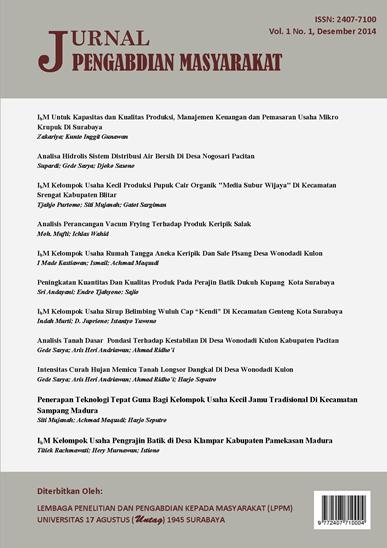
Penerapan Teknologi Tepat Guna Bagi Kelompok Usaha Kecil Jamu Tradisional di Kecamatan Sampang Madura
DOI:
https://doi.org/10.30996/jpm17.v1i01.356Abstract
Abstract. The market opportunities of herb medicine in Indonesia is quite widespread both for domestic needs and for export. Domestic demand for herb medicine was increased each year. This mean that the opportunities to develop the household or small scale herb industries in Indonesia are needed, one of the most popular place of herb medicine in Indonesia is Madura Island, especially in this present the local government of Sampang District concern to develop the Central of Herb Medicine in Jl Pahlawan, and they called “Herb Medicine Putri Pahlawan Cluster. According to our survey we found that they have several problems in management such as marketing, financial and technology, therefore we over the management training to the members of cluster and make a machine or applied technology for producing in the bigger volume ofproduction.
Â
Keywords: Applied Technologi, Marketing Management and Finacial management
Downloads
References
Abdul Wahab, S. (1997). Analisis Kebijak-sanaan dari Formulasi ke Implementasi Kebijaksanaan Negara. Jakarta: Bumi Aksara.
Abdul Wahab, S. (1999). Analisis Kebijakan Publik Teori dan Aplikasinya. Malang: Danar Wijaya.
Alamgir, M. and P. Arora. (1991). Providing Food Security for All. New York: University Press for The International Fund for Agricultural Development.
Ariani, M. (2006). Diversifikasi Konsumsi Pangan di lndonesia: Antara Harapan dan Kenyataan. Dalam: Suradisastra dkk (Penyunting). Diversifikasi Usahatani dan Konsumsi: Suatu Alternatif' Peningkatan Kesejahteraan Rumah Tangga Petani.
Monograph Series No. 27. Pusat Analisis Sosial Ekonomi dan Kebijakan Pertanian, Bogor.
Barker, R., and J.W. Kijne. (2001). Improving Water Productivity in Agricalture: A Review of Literature. Background paper prepared for SWIM Water Productivity Workshop, November 2001. International Water Management Institute (IWMI), Colombo.
Bhuiyan, S.I., T.P.Tuong, and L.J.Wade. (1998). Management of Water as A Scarce Resource: Issues and Options in Rice Culture. In: N.G. Dowling, S.M.
Greenfield, and K.S. Fischer (Eds.). Sustaina-bility of Rice in the Global Food System. Pasific Basin Study Center, International Rice Research Institute (IRRI), Los Banos.
Budiman, Arief. (1991). Negara dan Pemba-ngunan, Studi tentang Indonesia dan Korea Selatan. Jakarta: Yayasan Padi dan Kapas.
Buckman, G. (2004). Globalization : Tame it or Scrap it? New York: St Martin's Press.
Byron, W.J. (1988). On the Protection and Promotion of the Right to Food: In Ethical Reflection. In B.W.J. LeMay (eds.), Sience, Ethics, and Food. Washington, D.C.: Smithsonian lnstitution Press and lnterna-tional Rice Research Institute, Manila.
BPS. (2009). Pendataan Usahatani 2009 (PUT09). Jakarta: Badan Pusat Statistik.
Campo, SS & PSA Sundaram. (2001). Impro-ving Public Administration in a Compe-titive World. Asian Development.
Chambers, R. and G. Conway (1992). Sustai-nable rural livelihoods: Practical concepts for the 2l st century. IDS Discussion Papcr 296. Brighton: IDS. (pp.7-8)
Downloads
Published
Issue
Section
License
COPYRIGHT NOTICE
The copyright in this website and the material on this website (including without limitation the text, computer code, artwork, photographs, images, music, audio material, video material and audio-visual material on this website) is owned by PM17: Jurnal Pengabdian Masyarakat and its licensors.
Copyright license
JPM17: Jurnal Pengabdian Masyarakat grants to you a worldwide non-exclusive royalty-free revocable license to:
- View this website and the material on this website on a computer or mobile device via a web browser;
- Copy and store this website and the material on this website in your web browser cache memory; and
- Print pages from this website for your
- All articles published by PM17: Jurnal Pengabdian Masyarakat are licensed under the creative commons attribution 4.0 international license. This permits anyone to copy, redistribute, remix, transmit and adapt the work provided the original work and source is appropriately cited.
JPM17: Jurnal Pengabdian Masyarakat does not grant you any other rights in relation to this website or the material on this website. In other words, all other rights are reserved.
For the avoidance of doubt, you must not adapt, edit, change, transform, publish, republish, distribute, redistribute, broadcast, rebroadcast or show or play in public this website or the material on this website (in any form or media) without appropriately and conspicuously citing the original work and source or JPM17: Jurnal Pengabdian Masyarakat prior written permission.
Permissions
You may request permission to use the copyright materials on this website by writing to compliance@academicjournals.org.
Enforcement of copyright
JPM17: Jurnal Pengabdian Masyarakat takes the protection of its copyright very seriously.
If JPM17: Jurnal Pengabdian Masyarakat discovers that you have used its copyright materials in contravention of the license above, JPM17: Jurnal Pengabdian Masyarakat may bring legal proceedings against you seeking monetary damages and an injunction to stop you using those materials. You could also be ordered to pay legal costs.
If you become aware of any use of ACADEMIC JOURNALS' copyright materials that contravenes or may contravene the license above, please report this by email to compliance@academicjournals.org.
Infringing material
If you become aware of any material on the website that you believe infringes your or any other person's copyright, please report this by email to jpm17@untag-sby.ac.id
target="_blank"