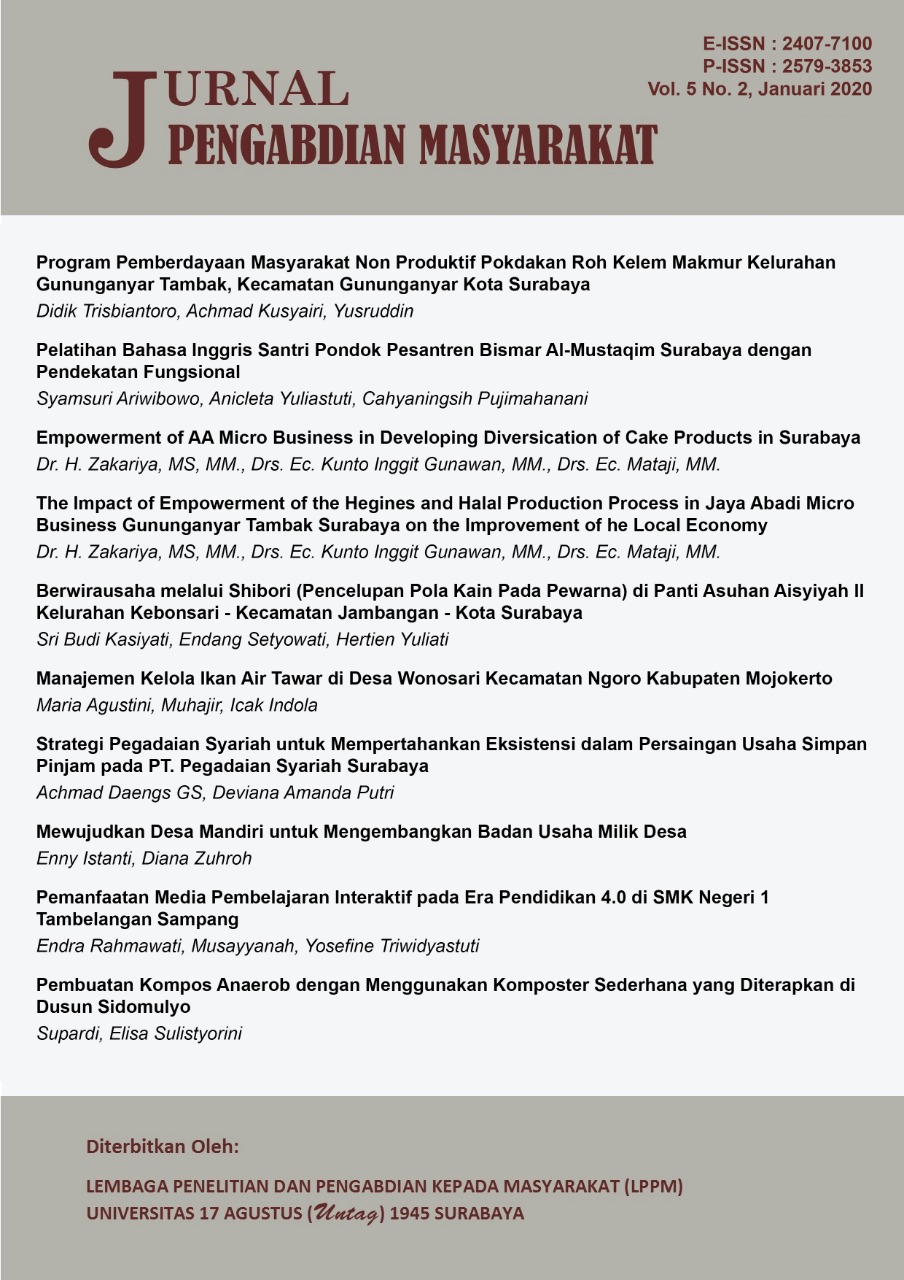
EMPOWERMENT OF AA MICRO BUSINESS IN DEVELOPING DIVERSICATION OF CAKE PRODUCTS IN SURABAYA
DOI:
https://doi.org/10.30996/jpm17.v5i2.4189Abstract
Since the enactment of the Asean Economic Community (AEC) at the end of 2015 should encourage all economic actors including SMEs and Micro Enterprises to improve themselves in order to improve the quality of production of both goods and services. If it is not done, then Indonesia is a "soft" market for other Asean countries because Indonesia has the largest population (population size) in ASEAN, which is no less than 270 million inhabitants. SMEs and Micro Enterprises, which are the embodiment of people's economic democracy, are devastated when the flow of goods and services so swiftly from various Asean Countries invades the Indonesian market. Realizing that doing empowering SMEs and Micro Enterprises is a necessity and a necessity to be able to find national identity that has comparative advantage and competitive advantage. This activity begins with identifying the existing problems and then finding a solution method, the method used is to provide training and assistance. The results that have been achieved are the existence of AA business capabilities that produce 10 (ten) additional additional new products which include: 1. Sus Fla; 2. Sus Fla Buah; 3. Sus Rogut; 4. Cum-cum; 5. Panada; 6. Layers; 7. Brown sugar steamed buns; 8. Bongko menthuk; 9. Risol mayo; and Sausage solo. In addition, Micro Business "AA" can improve its ability in the field of simple bookkeeping and business management. The existence of these outcomes is an indication of increased business empowerment.
Keywords: Empowerment- Product Diversification- Cake.
Downloads
References
Ertl, P., Knaus, W., & Zollitsch, W. (2016). An approach to including protein quality when assessing the net contribution of livestock to human food supply. Animal, 10 (11), 1883–1889. https://doi.org/10.1017/S1751731116000902.
Goodman, R. M., Speers, M. A., McLeroy, K., Fawcett, S., Kegler, M., Parker, E., … Wallerstein, N. (1998). Identifying and Defining the Dimensions of Community Capacity to Provide a Basis for Measurement. Health Education and Behavior, 25(3), 258–278. https://doi.org/10.1177/109019819802500303
Grantham-McGregor, S., Cheung, Y. B., Cueto, S., Glewwe, P., Richter, L., & Strupp, B. (2007). Developmental potential in the first 5 years for children in developing countries. Lancet, 369(9555), 60–70. https://doi.org/10.1016/S0140-6736(07)60032-4
Headey, D., Hirvonen, K., & Hoddinott, J. (2018). Animal sourced foods and child stunting. American Journal of Agricultural Economics, 100(5), 1302–1319. https://doi.org/10.1093/ajae/aay053
Downloads
Published
Issue
Section
License
COPYRIGHT NOTICE
The copyright in this website and the material on this website (including without limitation the text, computer code, artwork, photographs, images, music, audio material, video material and audio-visual material on this website) is owned by PM17: Jurnal Pengabdian Masyarakat and its licensors.
Copyright license
JPM17: Jurnal Pengabdian Masyarakat grants to you a worldwide non-exclusive royalty-free revocable license to:
- View this website and the material on this website on a computer or mobile device via a web browser;
- Copy and store this website and the material on this website in your web browser cache memory; and
- Print pages from this website for your
- All articles published by PM17: Jurnal Pengabdian Masyarakat are licensed under the creative commons attribution 4.0 international license. This permits anyone to copy, redistribute, remix, transmit and adapt the work provided the original work and source is appropriately cited.
JPM17: Jurnal Pengabdian Masyarakat does not grant you any other rights in relation to this website or the material on this website. In other words, all other rights are reserved.
For the avoidance of doubt, you must not adapt, edit, change, transform, publish, republish, distribute, redistribute, broadcast, rebroadcast or show or play in public this website or the material on this website (in any form or media) without appropriately and conspicuously citing the original work and source or JPM17: Jurnal Pengabdian Masyarakat prior written permission.
Permissions
You may request permission to use the copyright materials on this website by writing to compliance@academicjournals.org.
Enforcement of copyright
JPM17: Jurnal Pengabdian Masyarakat takes the protection of its copyright very seriously.
If JPM17: Jurnal Pengabdian Masyarakat discovers that you have used its copyright materials in contravention of the license above, JPM17: Jurnal Pengabdian Masyarakat may bring legal proceedings against you seeking monetary damages and an injunction to stop you using those materials. You could also be ordered to pay legal costs.
If you become aware of any use of ACADEMIC JOURNALS' copyright materials that contravenes or may contravene the license above, please report this by email to compliance@academicjournals.org.
Infringing material
If you become aware of any material on the website that you believe infringes your or any other person's copyright, please report this by email to jpm17@untag-sby.ac.id
target="_blank"