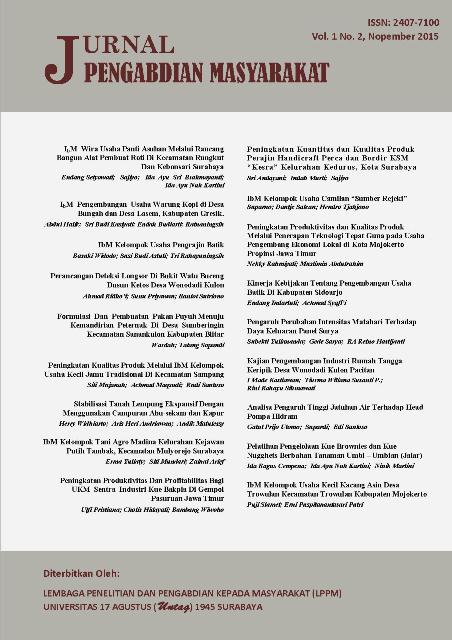
IbM PENGEMBANGAN USAHA WARUNG KOPI DIDESA BUNGAH DAN DESA LASEM, KABUPATEN GRESIK.
DOI:
https://doi.org/10.30996/jpm17.v1i02.526Abstract
Competitive advantage is the development of the value created by a business is able to buyers or advantage over competitors gained by delivering greater customer value. Competitive advantages due to the choice of the strategy undertaken by an attempt to seize the market. Strategies to gain a competitive advantage is cost leadership, differentiation, and focus. There are several strategies to develop business coffee shop in order to gain a competitive advantage, namely by placing a banner, make a list of menus, providing free wifi facilities, Television, add equipment to drink coffee, add seating add to the table, providing storefront to put merchandise, repair buildings, painting again, keep records of business, process the coffee powder with roasted and milled coffee machine and raise capital in the form of merchandise. This strategy is done because coffee is a customer favorite drink regularly booked, the atmosphere of the coffee shop of choice, and customers come to the coffee shop to stay up to a few tens of minutes over coffee. The coffee shop is not just a cup of coffee, but a place to socialize. Through this strategy is expected to increase the number of customers, increased revenue and ultimately grow profits coffee shop smack Udin and Yuk Kastoyah. As a micro business owners, then they are free to choose the type of coffee used. To support the industry-coffee and help the economy in Indonesia.
Keywords: Business development, competitive advantage, micro-enterprises.
Downloads
References
Azar, Betty S.1989. Understanding and Using English Grammar. New Jersey: Prentice Hall.
Catford, J.C. 1974. A Linguistic Theory of Translation. London: Oxford University Press.
DeCapua, Andrea. 2008. Grammar for Teachers: A Guide to American English for Native and Non-Native Speakers. New York: Springer.
Johnston, Ian. 1999. The Metamorphosis. Malaspina University-College Namainamo, BC.
Kafka, Franz. 2008. Metamorfosis. (translated into Indonesian by Juni Liem). Yogyakarta: Homerian Pustaka.
Kridalaksana, Harimurti. 1974. Sikap dan Fungsi Bahasa. Nusa Indah: Ende-Flores.
Larson, M. 1991. Meaning Based Translation, A Guide to Cross-Language Equivalent. New York: University Press of America.
Mc. Guire, L. Selection Examination for Students Interpreters at the University of Ottawa. In canadian Modern Language Review. Vol. IV. No. 44.
Nababan, M. R. 1997. Aspek Teori Penerjemahan dan Pengalihbahasaan. Surakarta: PPS-UNS.
Newmark, P. 1987. A Textbook of Translation. Singapore: Prentice Hall.
Nida, E A. 1975. Componential Analysis of Meaning. An Introduction to Semantic Structures. London: Mountain & Co. Publisher.
Robson, Colin.1995. Real Word Research. New York : Blacmete Cambridge.
Samsuri. 1985. Tata Kalimat Bahasa Indonesia. PT. Sastra Hudaya: Jakarta Pusat.
Sneddon, James. N. 1996. Understanding Indonesian Grammar: A Student's Reference and Workbook. Washington:Arnold.
Soemarno, T. 1988. Hubungan Antara Lama Belajar dalam Bidang Penerjemahan, Jenis Kelamin, Kemampuan Berbahasa dan Tipe-tipe Kesilapan. Unpublished Desertation at Post-Graduate Program. Malang State University.
http://www.grammaring.com/the-difference-between-defining-and-non-defining-relative-clauses-0 (September 03, 2013).
Downloads
Published
Issue
Section
License
COPYRIGHT NOTICE
The copyright in this website and the material on this website (including without limitation the text, computer code, artwork, photographs, images, music, audio material, video material and audio-visual material on this website) is owned by PM17: Jurnal Pengabdian Masyarakat and its licensors.
Copyright license
JPM17: Jurnal Pengabdian Masyarakat grants to you a worldwide non-exclusive royalty-free revocable license to:
- View this website and the material on this website on a computer or mobile device via a web browser;
- Copy and store this website and the material on this website in your web browser cache memory; and
- Print pages from this website for your
- All articles published by PM17: Jurnal Pengabdian Masyarakat are licensed under the creative commons attribution 4.0 international license. This permits anyone to copy, redistribute, remix, transmit and adapt the work provided the original work and source is appropriately cited.
JPM17: Jurnal Pengabdian Masyarakat does not grant you any other rights in relation to this website or the material on this website. In other words, all other rights are reserved.
For the avoidance of doubt, you must not adapt, edit, change, transform, publish, republish, distribute, redistribute, broadcast, rebroadcast or show or play in public this website or the material on this website (in any form or media) without appropriately and conspicuously citing the original work and source or JPM17: Jurnal Pengabdian Masyarakat prior written permission.
Permissions
You may request permission to use the copyright materials on this website by writing to compliance@academicjournals.org.
Enforcement of copyright
JPM17: Jurnal Pengabdian Masyarakat takes the protection of its copyright very seriously.
If JPM17: Jurnal Pengabdian Masyarakat discovers that you have used its copyright materials in contravention of the license above, JPM17: Jurnal Pengabdian Masyarakat may bring legal proceedings against you seeking monetary damages and an injunction to stop you using those materials. You could also be ordered to pay legal costs.
If you become aware of any use of ACADEMIC JOURNALS' copyright materials that contravenes or may contravene the license above, please report this by email to compliance@academicjournals.org.
Infringing material
If you become aware of any material on the website that you believe infringes your or any other person's copyright, please report this by email to jpm17@untag-sby.ac.id
target="_blank"