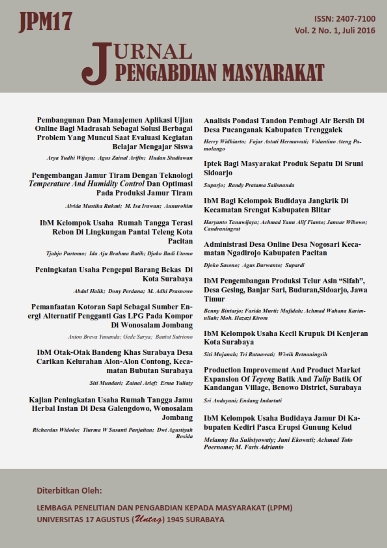
IbM KELOMPOK USAHA BUDIDAYA JAMUR DI KABUPATEN KEDIRI PASCA ERUPSI GUNUNG KELUD
DOI:
https://doi.org/10.30996/jpm17.v2i01.793Abstract
The eruption of Mount Kelud, located in Kediri-East Java that occurred in
early of 2014 resulted damages of some public facilities and also agricultural
land. Most of the people who lived that area are working as farmers and
ranchers. Many of the villagers became unproductive and could not perform
activities of farming and ranching. To solve such a problem, we would like to
encourage them by training how to cultivate mushroom Pleurotus ostreatus or
known as “Tiram†mushroom. The expectation of this activity is they can be
independently economically by cultivating mushrooms in their area after the
eruption of Mount Kelud.
Keywords: Pleurotus spp, eruption, cultivate, Tiram mushroom, Kediri
Downloads
References
DAFTAR PUSTAKA
Allen, C. (2010). Multicultural literature. http://courses.unt.edu/efiga/HistoryAnd Ethnography/TrendsProjects/Cynthia_Allen/callenpaper.htm. Akses: 22-04-2016
Andayani, A. (1997). Nature as the inspiration source in Herman Melville’s Moby Dick. FSU in the Limelight 5(2) July: p. 103-108.
Andayani, A. (2003). Sartre’s existentialism in Herman Melville’s Moby Dick. Parafrase 3(1) February: p. 41-46.
Andayani, A. (2005). Literacy stylistics in Herman Melville’s Moby Dick: The study of arrangement of ideas. Parafrase 5(1) February: p. 33-39.
Andayani, A. (2012). Existentialism in Mochtar Lubis’ Harimau Harimau and Herman Melville’s Moby Dick: Comparative literary study. Dlm. Misnadin & Masduki (ed.), Prosiding Semnas: Wacana Bahasa dan Sastra Bandingan sebagai Khasanah Nusantara. Surabaya: CV PMN& Prodi Sastra Inggris Unijoyo Bangkalan.
Bates,R. (2012). Defeating the white whale of race hatred. http://betterlivingthrough beowulf.com/defeating-the-white-whale-of-race-hatred/ Akses: 22-04-2016
Budiman, M. (1998). Sastra dan representasi. Junal Kalam, ed. 11.
Ambar A. & Endang P. – Representasi Multikulturalisme dalam Novel Moby Dick
Parafrase Vol. 16 No.01 Mei 2016
Cope, D. (2004). Whiteness, blackness, and sermons to sharks: Race in Melville's Moby Dick. http://www.poetspath.com/Dave_Cope/Dick.htmAkses: 22-04-2016
Darma, B. (2011). Sasra dan pluralisme. Makalah Semnasdi Fakultas Bahasa dan Seni UNJ, Oktober 2011.
Endraswara, S. (2013). Metodologi penelitian sastra: Epistemologi, model, teori dan aplikasi. Yogyakarta: Pustaka Widyatama.
Friedlander, E. (2005). Enjoying Moby Dick by Herman Melvilleâ€. http://www.pathguy.com/ mobydick.htmAkses: 22-04-2016
Glazier, J. &Seo, Jung-A. (2005). Multicultural literature and discussion as mirror and window? Journal of Adolescent & Adult Literacy, 48(8) May, p.686-700.
Jacquinot,L. (2014). The question of race; Or, how Ahab, Ishmael, and Moby-Dick. https://prezi.com/t6rdlo4-xllc/the-question-of-race-or-how-ahab-ishmael-and-moby-dick/Akses: 22-04-2016
Jeong,L. (2015). Moby-Dick Herman Melville: Themes, motifs & symbols. http://www. sparknotes.com/lit/mobydick/themes.htmlAkses: 22-04-2016
Hill, R. (2011). "The color of authenticity in multicultural literature."VOYA (Dec. 2011): 445-447. https://ccbc.education.wisc.edu/books/multicultural.asp. Akses: 22-04-2016
Hoagland, D. (2010).Multicultural literature: Literature changes lives. https://cltlblog. wordpress.com/2010/07/21/multicultural-literature-literature-changes-lives/Akses: 22-04-2016
Kurniawan, E. (2014). Queequeg. http://ekakurniawan.com/tag/herman-melvilleAkses: 22-04-2016
Downloads
Published
Issue
Section
License
COPYRIGHT NOTICE
The copyright in this website and the material on this website (including without limitation the text, computer code, artwork, photographs, images, music, audio material, video material and audio-visual material on this website) is owned by PM17: Jurnal Pengabdian Masyarakat and its licensors.
Copyright license
JPM17: Jurnal Pengabdian Masyarakat grants to you a worldwide non-exclusive royalty-free revocable license to:
- View this website and the material on this website on a computer or mobile device via a web browser;
- Copy and store this website and the material on this website in your web browser cache memory; and
- Print pages from this website for your
- All articles published by PM17: Jurnal Pengabdian Masyarakat are licensed under the creative commons attribution 4.0 international license. This permits anyone to copy, redistribute, remix, transmit and adapt the work provided the original work and source is appropriately cited.
JPM17: Jurnal Pengabdian Masyarakat does not grant you any other rights in relation to this website or the material on this website. In other words, all other rights are reserved.
For the avoidance of doubt, you must not adapt, edit, change, transform, publish, republish, distribute, redistribute, broadcast, rebroadcast or show or play in public this website or the material on this website (in any form or media) without appropriately and conspicuously citing the original work and source or JPM17: Jurnal Pengabdian Masyarakat prior written permission.
Permissions
You may request permission to use the copyright materials on this website by writing to compliance@academicjournals.org.
Enforcement of copyright
JPM17: Jurnal Pengabdian Masyarakat takes the protection of its copyright very seriously.
If JPM17: Jurnal Pengabdian Masyarakat discovers that you have used its copyright materials in contravention of the license above, JPM17: Jurnal Pengabdian Masyarakat may bring legal proceedings against you seeking monetary damages and an injunction to stop you using those materials. You could also be ordered to pay legal costs.
If you become aware of any use of ACADEMIC JOURNALS' copyright materials that contravenes or may contravene the license above, please report this by email to compliance@academicjournals.org.
Infringing material
If you become aware of any material on the website that you believe infringes your or any other person's copyright, please report this by email to jpm17@untag-sby.ac.id
target="_blank"