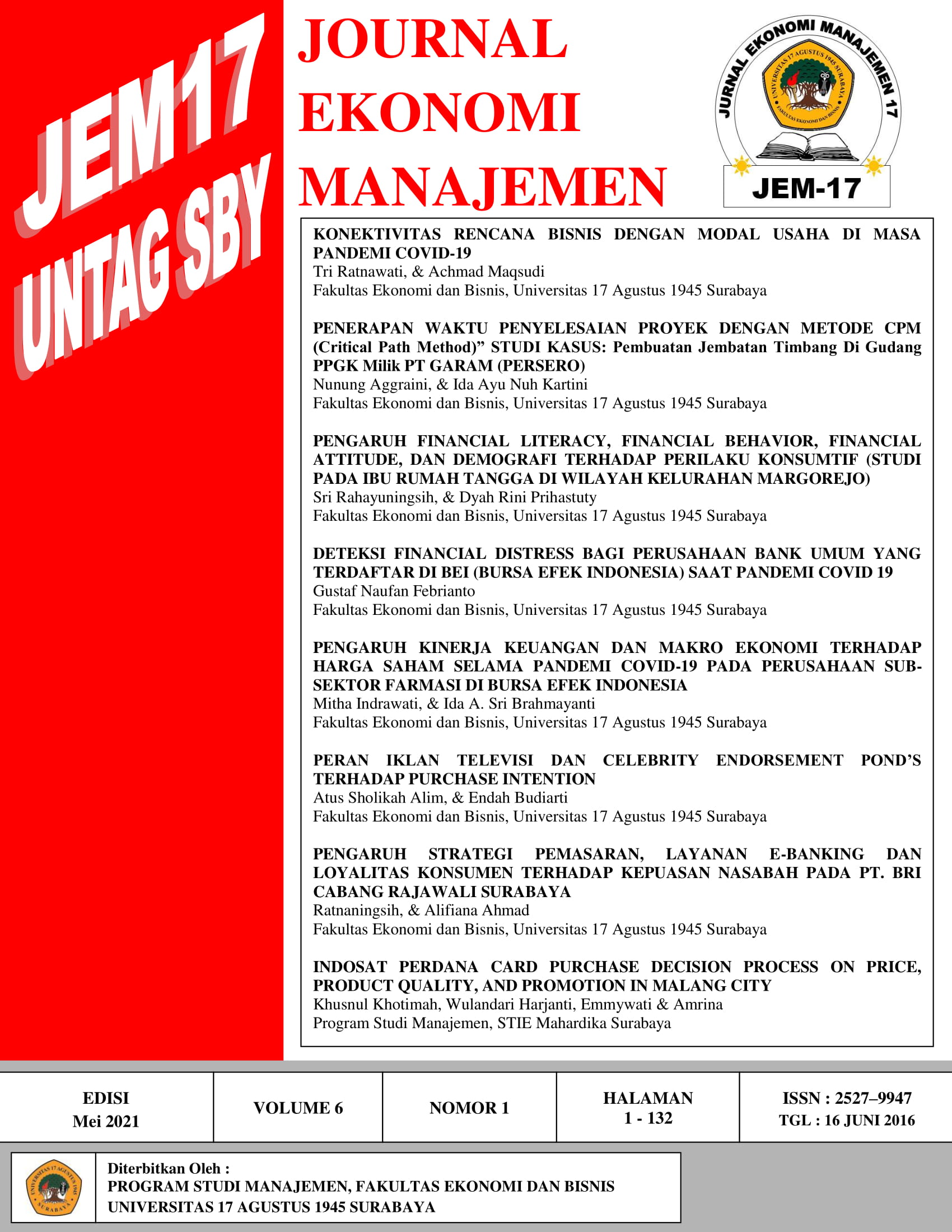
PENERAPAN WAKTU PENYELESAIAN PROYEK DENGAN METODE CPM (Critical Path Method)” STUDI KASUS: Pembuatan Jembatan Timbang Di Gudang PPGK Milik PT GARAM (PERSERO)
DOI:
https://doi.org/10.30996/jem17.v6i1.5273Keywords:
Waktu, Jalur Kritis, dan Metode CPMAbstract
Tujuan penelitian yang ingin dicapai sesuai dengan rumusan masalah yang telah dipaparkan adalah untuk mengetahui, meneliti dan penerapan metode CPM (Critical Path Method) dalam penjadwalan kembali pada proyek pembangunan jembatan timbang kapasita 60 Ton milik PT Garam (Persero). Hasil akhir dari penelitian ini adalah gambaran mengenai penerapan metode CPM pada satu proyek. Penelitian ini merupakan penelitian action research dengan menggunakan metode CPM (Critical Path Method). Data yang digunakan dalam penelitian adalah data primer dan data sekunder. Data primer dalam penelitian ini adalah data tentang berapa lama proyek pembangunan jembatan timbang kapasitas 60 Ton dan biaya yang dikeluarkan untuk pembangunan jembatan timbang kapasitas 60. Berdasarkan hasil penelitian diketahui bahwa proyek pembangunan jembatan timbang kapasitas 60 ton berdasarkan metode CPM selama 67 hari. Sedangkan biaya yang keluar untuk proyek pembangunan proyek jembatan timbang kapasitas 60 ton berdasarkan jalur kritis metode CPM sebesar Rp.689.875.000. Dari segi biaya, penyelesaian proyek pembangunan proyek jembatan timbang kapasitas 60 ton akan mengefisiensi biaya sebesar 3% dari biaya proyek PT BUMIKU.Downloads
References
Alkan, N. N. (2016). Psychological Sense of University Membership: An Adaptation Study of the PSSM Scale for Turkish University Students. https://doi.org/10.1080/00223980.2015.1087373
Demanet, J., & van Houtte, M. (2012). School Belonging and School Misconduct: The Differing Role of Teacher and Peer Attachment. Journal of Youth and Adolescence, 41(4), 499–514. https://doi.org/10.1007/s10964-011-9674-2
Diebel, Tara; Woodcock, Colin; Cooper, C; Brignell, C. (2016). Establishing the effectiveness of a gratitude diary intervention on children’s sense of school belonging. Unversity of Southampton.
Dukynait?, R., & Dudait?, J. (2017). Influence of school factors on students’ sense of school belonging. New Educational Review, 47(1), 39–52. https://doi.org/10.15804/tner.2017.47.1.03
Faircloth, B. S., & Hamm, J. V. (2011). The dynamic reality of adolescent peer networks and sense of belonging. Merrill-Palmer Quaterly, 1(57). https://doi.org/10.1353/mpq.2011.0004
Fong Lam, U., Chen, W.-W., Zhang, J., & Liang, T. (2015). It feels good to learn where I belong: School belonging, academic emotions, and academic achievement in adolescents. School Psychology International, 36(4), 393–409. https://doi.org/10.1177/0143034315589649
Freeman, T. M., Anderman, L. H., & Jensen, J. M. (2007). Sense of belonging in college freshmen at the classroom and campus levels. The Journal of Experimental Education, 3(75), 203–220. https://doi.org/10.3200/JEXE.75.3.203- 220
Goodenow, C. (1993). Classroom belonging among early adolescent students: Relationships to motivation and achievement. Journal of Early Adolescence, 13, 21–43. https://doi.org/10.1177/0272431693013001002
Goodenow, C. (2015). The psychological sense of school membership among adolescents. Psychology in the Schools, 30(January 1993), 70–90. https://doi.org/10.1002/1520-6807(199301)30
Karen F. Osterman. (2000). Students’ Need for Belonging in the School Community. Review of Educational Research, 70(3), 323–367. https://doi.org/https://doi.org/10.3102/00346543070003323
Mccullough, M. E., Emmons, R. A., & Tsang, J.-A. (2002). The Grateful Disposition: A Conceptual and Empirical Topography. https://doi.org/10.1037/0022-3514.82.1.112
Peter Trower, Jason Jones, W. D. (2009). Cognitive Behavioural Counselling in Action. SAGE Publications Ltd.
Pittman, L. D., & Richmond, A. (2007). Academic and psychological functioning in late adolescence: The importance of school belonging. The Journal of Experimental Education, 4(75), 270–290. https://doi.org/10.3200/JEXE.75.4.270- 292
Seligman, M. E. P. (2004). Authentic Happiness: Using the New Positive Psychology to Realize Your Potential for Lasting Fulfillment. Free Press.
Seligman, M. E. P., Steen, T. A., Park, N., & Peterson, C. (2005). Positive psychology progress: empirical validation of interventions. The American Psychologist, 60(5), 410–421. https://doi.org/10.1037/0003-066X.60.5.410
Wang, M.-T., & Eccles, J. S. (n.d.). Social Support Matters: Longitudinal Effects of Social Support on Three Dimensions of School Engagement From Middle to High School. https://doi.org/10.1111/j.1467-8624.2012.01745.x
Watkins, P. C. (2014). Gratitude and the Good Life Toward a Psychology of Appreciation. Springer.
Willms, J. D. (2003). STUDENT ENGAGEMENT AT SCHOOL A SENSE OF BELONGING AND PARTICIPATION RESULTS FROM PISA 2000.
Downloads
Published
Issue
Section
License
Authors whose manuscript is published will approve the following provisions:
- The right to publication of all journal material published on the JEM17: Jurnal Ekonomi Manajemen website is held by the editorial board with the author's knowledge (moral rights remain the property of the author).
- The formal legal provisions for access to digital articles of this electronic journal are subject to the terms of the Creative Commons Attribution-ShareAlike (CC BY-SA) license, which means JEM17: Jurnal Ekonomi Manajemen reserves the right to store, modify the format, administer in the database, maintain and publish articles without requesting permission from the Author as long as it keeps the Author's name as the owner of Copyright.
- Printed and electronically published manuscripts are open access for educational, research, and library purposes. In addition to these objectives, the editorial board shall not be liable for violations of copyright law.