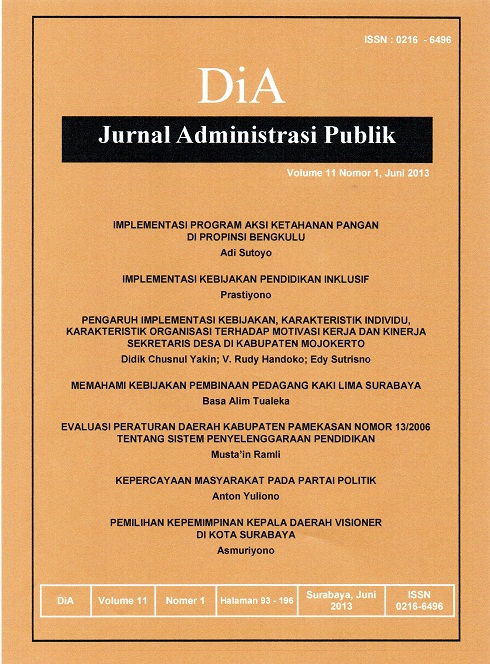
Evaluasi Peraturan Daerah Kabupaten Pamekasan Nomor 13/2006 Tentang Sistem Penyelenggaraan Pendidikan
DOI:
https://doi.org/10.30996/dia.v11i01.297Abstract
Education as a means to foster and enhance the dignity of the nation, the major media to revive the character of the Indonesian nation, and as the formation of the concept of nationalism. Education system in Indonesia has been viewed yet managed to build Indonesia's human character. The system of education in Pamekasan been contained in Regulation No. 13 Year 2006 on Implementation of Education. However, these regulations do not contain the concept of education in a comprehensive and substantial, so it does not have a significant impact on the character development of students.Based on the basic ideas of this study very strategic position to evaluate the education legislation, in order, first to analyze why education is not effective regulation, so it has not had a positive impact for the formation of the character of the students, both to analyze the factors causing ineffective education regulations. All three analyzes efforts to streamline the regulation of education in character building of students. The research was conducted using qualitative research approach by interview, observation, and document analysis. The findings of this study is the first regional district education Pamekasan Regulation No. 13 of 2006 did not have a positive impact in shaping the character of the students, so that local regulations are necessary improvements, as some criteria for the success of the policy is not optimal. Second, causes no impact to the effective education of local regulations; lack of socialization, lack of loyalty and quality of human resources, lack of facilities and supporting infrastructure, lack of commitment to implementing education, low exemplary teachers, and the lack of unity among all stakeholders of education in shaping the character of students. Third, for effective implementation of local regulations in order to have a positive impact on the educational development of students' character; matter of local regulations must contain a substantial character education and konperhenship, the operational guidelines and institutional character education, the commitment of the implementers to implement local regulations with good education (good execution). The monitoring and evaluation, penalties for students who violate firmly and pedagogical. Recommended study: Required the improvement of local regulations to be more done about the substantial and comprehensive character education. Regulations required the regents. Socialization improving local regulations evenly to the level of the educational unit. The existence of monitoring and evaluation team. And the presence of adequate support from the local government.
Keyword : Character Education National Policy - Local Policies – Policy Evaluation – Students Build CharacterDownloads
References
Baldauf, R.B. & Jernudd, B.H. (1983). Language of publication as a variable in scientific communication. Australian Review of Applied Linguistics, vol. 6, pp. 97-108.
Cahyono, B.Y. (1992). The questioning skills of reading teachers. TEFLIN Journal vol.5, no. 2, pp. 69-84.
Canagarajah, A. (1996). From critical research to research reporting. TESOL Quarterly, vol. 30, pp. 321-330.
Carter-Sigglow, J. (1996). Correspondence. Nature vol. 384, p. 764.
Editorial. Relevansi laporan universitas-universitas terbaik 1998 “Asiaweekâ€. Kompas, May 30th , 1998. available at: http://www.kompas.com/9805/30/OPINI/taju45.htm (30 May, 1998).
Flowerdew, J. (1999a). Problems in writing for scholarly publication in English: The case of Hong Kong. Journal of Second Language Writing, vol. 8, pp. 243-248.
Flowerdew, J. (1999b). Writing for scholarly publication in English: The case of Hong Kong. Journal of Second Language Writing, vol. 8, pp. 123-145.
Flowerdew, J. (2000). 'Discourse community, legitimate-peripheral participation, and the non-native English-speaking scholar.' TESOL Quarterly, vol. 34, pp. 127-150.
Gibbs, W.W. (1995). Trends in scientific communication: Lost science in the third world. Scientific American, August, pp. 76-83.
Gupta, R. (1995). Managing general an specific information in introduction. English for Specific Purposes, vol. 14, pp. 59-75.
Downloads
Published
How to Cite
Issue
Section
License
The DiA journal allows authors to retain the copyright of their papers without limitation. Authors may grant publishers non-exclusive publishing rights to publish articles. Granting first publishing rights to publishers also qualifies as unlimited copyright (because there are no restrictions imposed by publishers on author copyright).