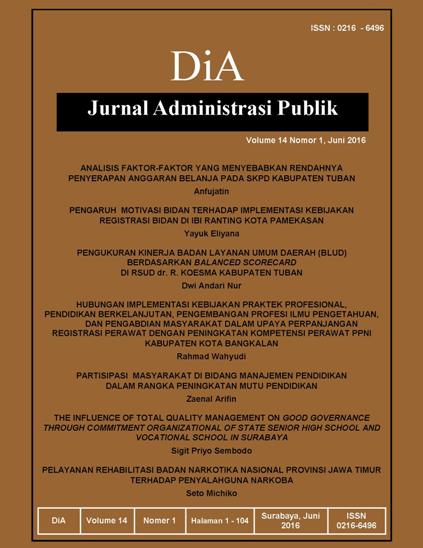
PENGUKURAN KINERJA BADAN LAYANAN UMUM DAERAH (BLUD) BERDASARKAN BALANCED SCORECARD DI RSUD dr. R. KOESMA KABUPATEN TUBAN
DOI:
https://doi.org/10.30996/dia.v14i01.1016Abstract
Work Measurement is a management controlling in a company to investigate the work standard if the organization reaches the target or not. In Ministry of Home Affairs’ decree number 61 at 2007, article 127 clause 2 which pointed that the BLUD evaluation and assessment work is purposed to measure the level of the BLUD result management achievement is like decreed in business strategy and estimate plan. One of the work measurement methods comprehensively is using the balanced scorecard. It uses four perspectives; they are the customer perspective, the financial perspective, the internal business process perspective, and the learning and growth perspective. This research aim is to analyze Badan Layanan Umum Daerah work in the customer perspective, the financial perspective, the internal business process perspective, and the learning and growth perspective. This research method is quantitative descriptive, uses primary and secondary data. To measure the customer perspective work, it uses customer satisfaction survey to 100 patients. To measure the financial perspective, it uses liquidity, solvency and activity ratios. The internal business process perspective uses the indicator of outpatient and hospitalization service measurement. While the learning and growth perspective uses employee work satisfaction survey to 87 employees of RSUD dr. Koesma Tuban district. The research result in RSUD dr. Koesma Tuban district can be concluded that from the result financial perspective measurement can be categorized to measure financial perspective. There is one ratio with deficient category from three ratios which are measured, it is activity ratio. The internal business process perspective measurement, for outpatient indicator is gotten from outpatient visit which tends to increase year by year, and hospitalization indicator only has four of six indicators which are not in ideal value. Meanwhile, the learning and growth perspective can be categorized in good enough.
Key Word: Work Mesurement, Balanced Scorecard, RSUD dr. R. Koesma TubanDownloads
References
Buku :
Budianta, Melani, dkk. 2002. Membaca
Sastra (Memahami Sastra untuk
Maya P. & Eva A. –Bisnis Persewaan Keluarga dalam Naskah Drama Televisi
Perguruan Tinggi). Magelang :
Indonesia Tera.
Darmono, Sapardi Djoko. 2003. Sosiologi
Sastra. Semarang : Undip.
Emiko, Ochiai. 1997. The Japanese
Family System in Transition.
Jepang : LTCB International
Library Foundation.
Faruk. 2010. Pengantar Sosiologi Sastra.
Yogyakarta : Pustaka Pelajar.
Khairudin. 2008. Sosiologi Keluarga.
Jakarta : Bumi Aksara
Kurniawan, Heru. 2012. Teori, Metode,
dan Aplikasi Sosiologi Sastra.
Yogyakarta : Graha Ilmu.
Moleong, Lexy J. 1998. Metode
Penelitian Kualitatif. Bandung :
PT Remaja Rosdakarya .
Morita, Y. 2001. The Comparative Study
on Bullying in Four Countries.
Downloads
Published
How to Cite
Issue
Section
License
The DiA journal allows authors to retain the copyright of their papers without limitation. Authors may grant publishers non-exclusive publishing rights to publish articles. Granting first publishing rights to publishers also qualifies as unlimited copyright (because there are no restrictions imposed by publishers on author copyright).