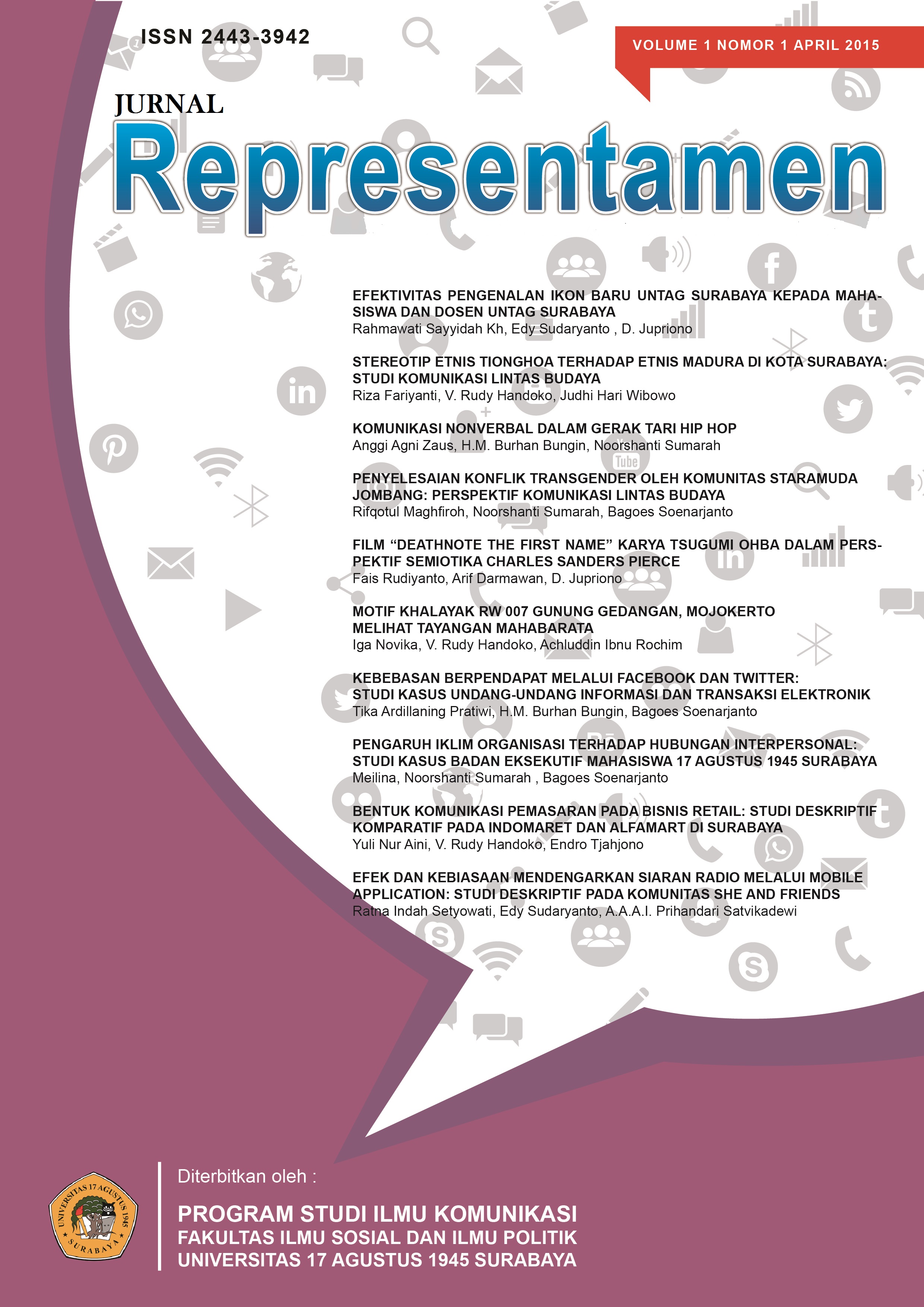
PENGARUH IKLIM ORGANISASI TERHADAP HUBUNGAN INTERPERSONAL: STUDI KASUS BADAN EKSEKUTIF MAHASISWA 17 AGUSTUS 1945 SURABAYA
DOI:
https://doi.org/10.30996/representamen.v1i01.1441Abstract
This research is motivated by the growing climate in an organization and interpersonal relationships
between members of an organization that is bound to happen because the real man is virtually impossible
to live without communicating. In an organization there are goals of the organization in which the
members of the organizational duties. Surely spada any organization that is therein AKN climate different
from the climate in other organizations. August 17, 1945 Surabaya University has six faculty that each -
each have the Mahasiswa.Hal Executive Board encourages the writer to determine whether there was an
effect of organizational climate on the interpersonal relationships of its members. The influence will
affect not or achievement of the organization itself. The method used in this study is a survey method is a
method of research using a questionnaire as a data collection instrument. While this kind of research is a
quantitative correlational research. This study uses a statistical formula product moment using data
processing SPSS 22 for windows conclusion that organizational climate (X) which includes indicators
Sense of Responsibility, Standard or expectations about quality, reward or reward, Sense of fraternity
and team spirit is weak effect on interpersonal relationships (Y ) which includes indicators of the
characteristics of individuals involved, the group properties, environmental properties Student Executive
Board UNTAG Surabaya worth of 2.54 which means that the level of influence is weak.
Keywords: effect, organizational climate, interpersonal relations.
Downloads
References
Card, Orson Scott. Character and Viewpoint. New York: Writer's Digers Books, 1988.
Dahl, Roald. Charlie and The Chocolate Factory. London: Alfred A. Knopf, Inc. (original), 1964.
Feist, Jess. Gregory J. Feist. Theories of Personality. 6th ed. New York: The Mcgraw-Hills companies, Inc, 2006.
Gregory, R. J. Psychological Testing: History, Principles, and Applications. 4th ed. United States of America: Pearson Education Group, Inc. 2004.
Ogden, C.K. The Psychoanalytic Theory of Neurosis. 1st. London: Kegan Paul, Trench, Trubner & Co., Ltd., 1946.
Milner, Max. Freud et L'intrepretation De La Literature. Paris: Societe d'Edition d'Enseignemet Superieur, 1984.
Murfin, Ross C. and Supriya M. Ray. The Bedford Glossary of Critical and Literary Terms. 3rd ed. St. Martins: Bedford, 2009.
Parker, Robert Dale. Critical Theory for Literary and Cultural Studies. 2nd ed. New York: Oxford University Press, 2008.
Thurschwell, Pamela. Sigmund Freud. 1st ed. New York: Routledge, 2000.
Wellek, Rene and Austin Warren. Theory of Literature. New York: Harcourt, Brace & World, 1956.
Website:
Organization, Roald Dahl. www.roalddahl.com. n.d. Casarotto Ramsay and Associates Ltd. (Access on Sunday, 18th June 2017)
aya_kerja_cemerlang.htm (diakses 25-12-
http://www.kompas.com/kesehatan/news/0601/1
/111409.htm (diakses 03-01-2015)
Kriyantono, Rachmat. 2006. Teori Praktis, Riset
Komunikasi. Jakarta: Kencana Predana
Media
Muhammad, Arni. 1989. Komunikasi
Organisasi. Jakarta : Bumi Aksara.
Mulyana, Deddy. 2000. Ilmu Komunikasi.
Bandung: Remaja Rosada karya.
Rakhmat, Jalaluddin, 2001 Metode Penelitian
Komunikasi. Bandung: Remaja Rosdakarya.
Vemmylia. 2009. Pengaruh Hubungan Interpersonal
dan Lingkungan Kerja terhadap
Kepuasan Kerja Karyawan pada PT PLN
Cabang Binjai. Skripsi tidak dipublikasikan.
Universitas Sumatra Utara
Published
Issue
Section
License
Authors whose manuscript is published will approve the following provisions:
The right to publication of all journal material published on the jurnal representamen website is held by the editorial board with the author's knowledge (moral rights remain the property of the author).
The formal legal provisions for access to digital articles of this electronic journal are subject to the terms of the Creative Commons Attribution-ShareAlike (CC BY-SA) license, which means Jurnal Representamen reserves the right to store, modify the format, administer in database, maintain and publish articles without requesting permission from the Author as long as it keeps the Author's name as the owner of Copyright.
Printed and electronic published manuscripts are open access for educational, research and library purposes. In addition to these objectives, the editorial board shall not be liable for violations of copyright law.