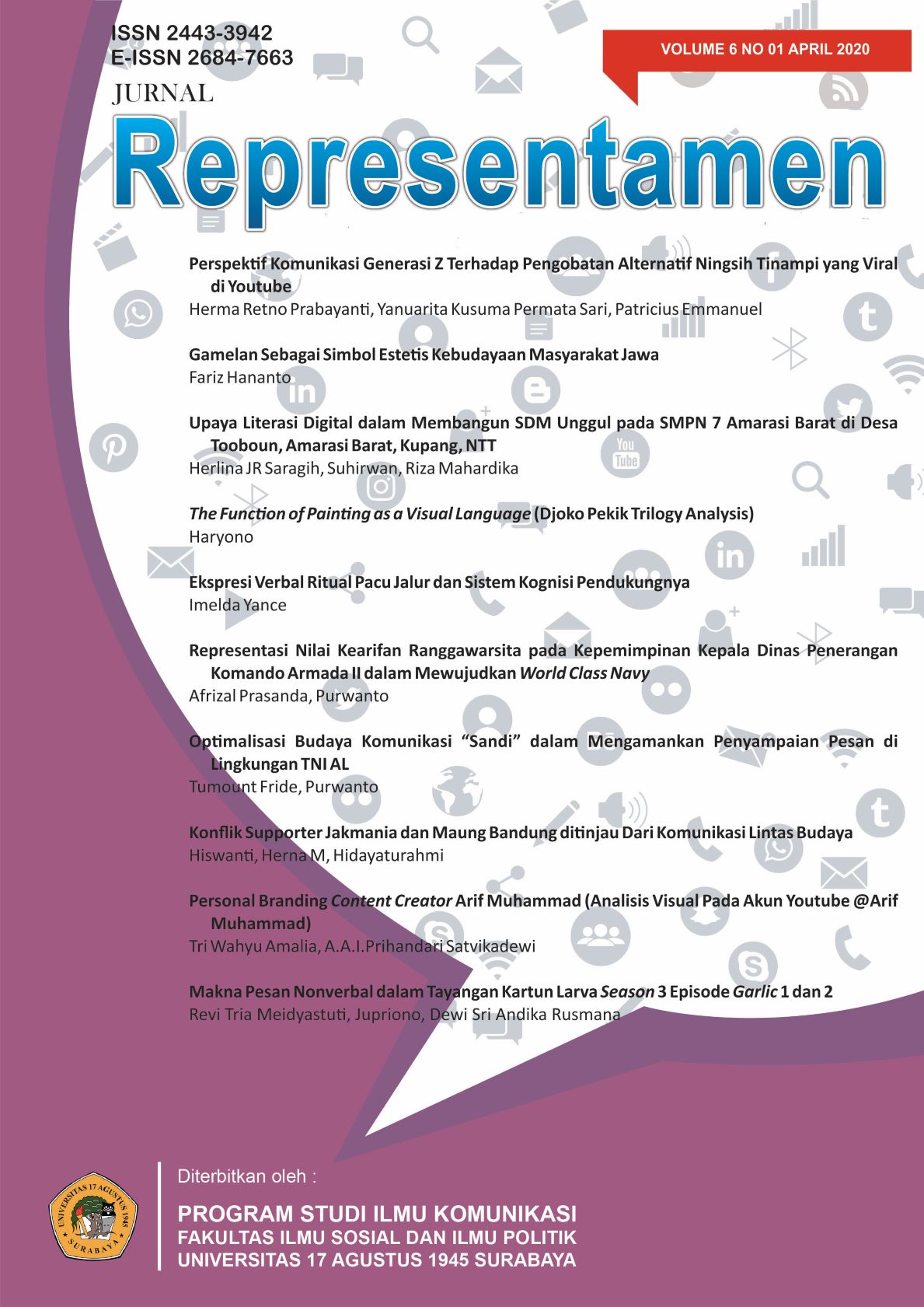
Personal Branding Content Creator Arif Muhammad (Analisis Visual pada Akun Youtube @Arif Muhammad)
DOI:
https://doi.org/10.30996/representamen.v6i01.3519Abstract
The emergence of more content creator, is the impact of social media development, especially youtube. Youtube became the most accessible platform on 2019. It requires content creators to create quality content and form personal branding, so they can compete and get recognition. This research will reveal the personal branding of a youtube content creator, namely Arif Muhammad or Mak Beti, who is trending on youtube because of his comedy content as a multirole. This qualitative study examines one video on @Arif Muhammad's youtube account, titled "Beti Pergi ke Mall", where in the video Arif played 15 characters. The study uses the visual methodology by Gillian Rose, from three areas of visual research, site of self, site of production, and site of audience. The results showed that personal branding of Arif Muhammad through the video in his youtube account, found 7 out of 8 main concepts of personal branding by Peter Montoya namely, Specialization, Leadership, Personality, Distinctiveness, Visibility, Persistance, and Goodwill. The law of strength is specialization. Personal Branding of Arif Muhammad make him called as The King of Youtube and King of Trending by his audience.
Keywords: personal branding, content creator, youtube
Downloads
References
Referensi
Bausert, S., Froh, J. J., Bono, G., Rose-Zornick, R., & Rose, Z. (2018). Gratitude in adolescence: Determinants and effects on development, prosocial behavior, and well-being.
In J. R. H. Tudge & L. B. d. L. Freitas (Eds.), Developing gratitude in children and adolescents (pp. 135-153). New York, NY, US: Cambridge University Press.
Chan, D. W. (2013). Counting blessings versus misfortunes: positive interventions and subjective well-being of Chinese school teachers in Hong Kong. Journal of Educational Psychology, Routledge Taylor & Francis Group, 33 (4), 504–519. doi.org/10.1080/01443410.2013.785046.
Chen, W., Niu, G. F., Zhang, D. J., Fan, C. Y., Tian, Y., & Zhou, Z. K. (2016). Socioeconomic status and life satisfaction in Chinese adolescents: Analysis of self-esteem as a mediator and optimism as a moderator. Personality and Individual Differences, 95, 105–109. https://doi.org/10.1016/j.paid.2016.01.036
Fanti, K. A., & Henrich, C. C. (2015). Effects of Self-Esteem and Narcissism on Bullying and Victimization During Early Adolescence. Journal of Early Adolescence, 35(1), 5–29. https://doi.org/10.1177/0272431613519498
Ghosh, A., & Deb, A. (2017). An exploration of gratitude themes and suggestions for future interventions. Journal of Human Behavior in the Social Environment, 27(7), 678–693. https://doi.org/10.1080/10911359.2017.1323068
Guindon, M. H (2010). Self Esteem Across The Lifespan. New York: Routledge Taylor & Francis Group.
Hikmawatty, S. (2019, June). Cegah kekerasan dengan membangun harga diri anak. Retrieved from https://www.cendananews.com.
Koentjoro. 2012. Kriminologi dalam perspektif psikologi sosial. Universitas Gadjah Mada, Yogyakarta.
Kong, F., Ding, K., Zhao, J. (2014). The Relationships among Gratitude, Self-esteem, Social Support and Life Satisfaction among Undergraduate Students. Journal Happiness Study. doi.org/10.1007/s10902-014-9519-2.
Leary, M. R., & Baumeister, R. F. (2000). The nature and function of self-esteem: Sociometer theory. In M. P. Zanna (Ed.), Advances in experimental social psychology, Vol. 32, pp. 1-62). San Diego, CA, US: Academic Press. http://dx.doi.org/10.1016/S0065-2601(00)80003-9.
Leary, M. R. (2004). The sociometer, self-esteem, and the regulation of interpersonal behavior. In R. F. Baumeister &
K. Vohs (Eds.), Handbook of self-regulation. New York: Guilford.
Listiyandini, R. A., Nathania, A., Syahniar, A., Sonia, L., Nadya, R. (2015) Mengukur Rasa Syukur: Pengembangan Awal Skala Bersyukur Versi Indonesia. Jurnal Psikologi Ulayat, 2 (2), 473-496.
Markum, M. E. (2009). Pengentasan Kemiskinan dan Pendekatan Psikologi Sosial. Psikobuana, 1(1), 1-12.
McCullough, M E, Kilpatrick, S. D., Emmons, R. A., & Larson, D. B. (2001). 8McCullough-GratitudeMoralAffect.pdf. Psychological Bulletin, Vol. 127, p. 249. Retrieved from http://psycnet.apa.org/journals/bul/127/2/249/
McCullough, Michael E., Emmons, R. A., & Tsang, J. A. (2002). The grateful disposition: A conceptual and empirical topography. Journal of Personality and Social Psychology, 82(1), 112–127. https://doi.org/10.1037/0022-3514.82.1.112
Mruk, C. J. (2006). Self-esteem Research, Theory, and Practice (3rded.). Spinger Publishing Company, Inc.
Nisfiannoor, Muhammad. (2009). Pendekatan Statistika Modern. Jakarta: Salemba Huamanika.
Oktalia, B. (2018). Efektivitas Program Psikoedukasi Pengembangan Self-esteem untuk Meningkatkan Self-Esteem Remaja Kelas 1. Universitas Tarumanagara
Ormrod, J. E., Anderman, E. A., & Anderman, L. H. (2017). Educational Psychology: Developing Learners (9th edition). Pearson.
Orth, U., & Robins, R. W. (2013). Understanding the Link Between Low Self-Esteem and Depression. Current Directions in Psychological Science, 22(6), 455–460. https://doi.org/10.1177/0963721413492763
Papalia, D. E., Feldman, R. D. (2014). Perkembangan Manusia (12ed).). Penerbit Salemba Humanika.
Peterson, C., & Seligman, M.E.P. (2004). Character Strength and Virtues: A Handbook & Classification. New York: Oxford University Press.
Rosenberg, M. (1965). Society and theadolescent self- image. Princeton, NJ: Princeton University Press.
Sang, C. C. (2015). Relationship between students’ family Socio-economic Status, Self esteem. International Journal of Education and Research, 3(2), 647–656. Retrieved from www.ijern.com
Santrock, J.W. (2008). Psikologi Pendidikan (jilid 2). Jakarta: Erlangga Snyder, C.R., & Lopez, S.J. (2005). Handbook of Positive Psychology. New York: Oxford University Press.
Sativa, R. A., Helmi, A. F. (2013). Syukur dan Harga Diri dengan Kebahagiaan Remaja. Jurnal Psikologi Wacana, 5(2).
Watkins, P. C., Woodward, K., Stone, T., & Kolts, R. L. (2003). Gratitude and happiness: Development of a measure of gratitude, and relationship with subjective well-being. Social Behavior & Personality: An International Journal, 31, 431-452.
Wood, A. M., Froh, J. J., & Geraghty, A. W. A. (2010). Gratitude and well-being: A review and theoretical integration. Journal of Clinical Psychology Review. doi.org/10.1016/j.cpr.2010.03.005.
Downloads
Published
Issue
Section
License
Authors whose manuscript is published will approve the following provisions:
The right to publication of all journal material published on the jurnal representamen website is held by the editorial board with the author's knowledge (moral rights remain the property of the author).
The formal legal provisions for access to digital articles of this electronic journal are subject to the terms of the Creative Commons Attribution-ShareAlike (CC BY-SA) license, which means Jurnal Representamen reserves the right to store, modify the format, administer in database, maintain and publish articles without requesting permission from the Author as long as it keeps the Author's name as the owner of Copyright.
Printed and electronic published manuscripts are open access for educational, research and library purposes. In addition to these objectives, the editorial board shall not be liable for violations of copyright law.