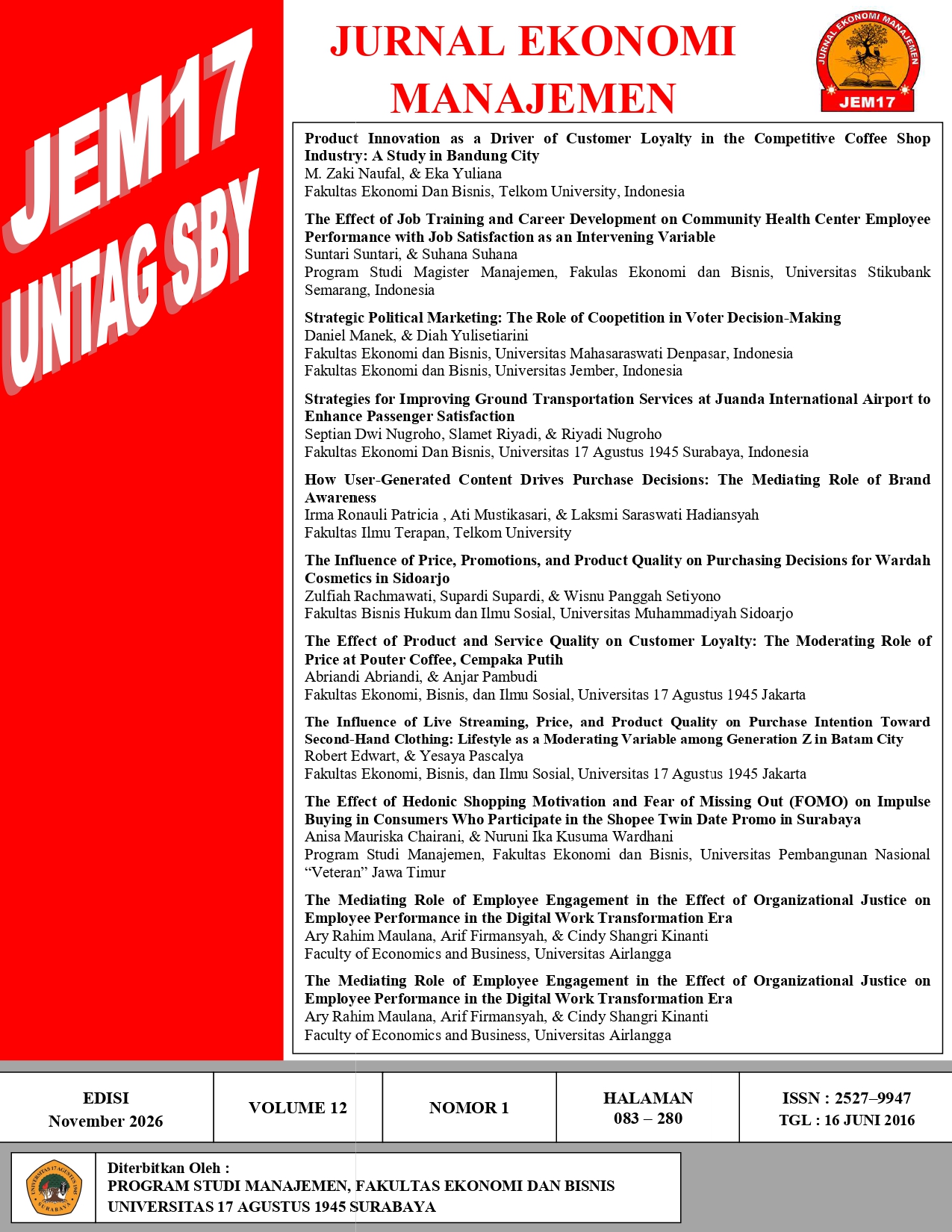
Strategic Political Marketing: The Role of Coopetition in Voter Decision-Making
DOI:
https://doi.org/10.30996/jem17.v11i2.133857Abstract
Contemporary political marketing has evolved beyond traditional campaign communication into a complex ecosystem characterized by strategic interaction, collaborative value creation, and psychological negotiation among political actors and voters. In emerging democracies such as Indonesia, political competition increasingly occurs within coalition-oriented systems where political actors simultaneously compete and collaborate to secure electoral legitimacy and governance stability. This study develops an integrated conceptual framework by synthesizing Rational Choice Theory, Service-Dominant Logic (SDL), cognitive dissonance theory, cultural value theory, and coopetition analysis to explain political decision-making within the Indonesian and Balinese sociopolitical context.
This research employs a quantitative explanatory approach using Structural Equation Modeling–Partial Least Squares (SEM-PLS). Data were collected from 600 respondents across five regencies/cities in Bali Province, including political party administrators, campaign volunteers, community leaders, and active voters. The study examines the relationships among Cultural Values, Coopetition, Cognitive Dissonance, and Political Decision-Making within political marketing strategies.
e-ISSN: 2527-9947/© 2024 The Authors
DOI:xxxxxxxxxxxxxx
Published by Fakultas Ekonomi dan Bisnis, Universitas 17 Agustus 1945 Surabaya.
Cultural values and coopetition significantly influence cognitive dissonance and political decision-making. Voters who strongly internalize collectivist norms and social harmony tend to experience psychological tension when political realities contradict cultural expectations. Coopetition also creates ambiguity in voter evaluations due to simultaneous political collaboration and competition. Furthermore, cognitive dissonance significantly mediates the relationships between cultural values, coopetition, and political decisions.The study contributes theoretically by integrating multiple perspectives into a unified political marketing framework and positioning cognitive dissonance as a central mechanism in management of political value co-creation and voter behavior.
Keywords: Political Marketing; Cognitive Dissonance; Coopetition; Rational Choice Theory; Cultural Values
Downloads
Downloads
Published
Issue
Section
License
Copyright (c) 2026 Daniel Manek, Diah Yulisetiarini

This work is licensed under a Creative Commons Attribution 4.0 International License.
Authors whose manuscript is published will approve the following provisions:
- The right to publication of all journal material published on the JEM17: Jurnal Ekonomi Manajemen website is held by the editorial board with the author's knowledge (moral rights remain the property of the author).
- The formal legal provisions for access to digital articles of this electronic journal are subject to the terms of the Creative Commons Attribution-ShareAlike (CC BY-SA) license, which means JEM17: Jurnal Ekonomi Manajemen reserves the right to store, modify the format, administer in the database, maintain and publish articles without requesting permission from the Author as long as it keeps the Author's name as the owner of Copyright.
- Printed and electronically published manuscripts are open access for educational, research, and library purposes. In addition to these objectives, the editorial board shall not be liable for violations of copyright law.