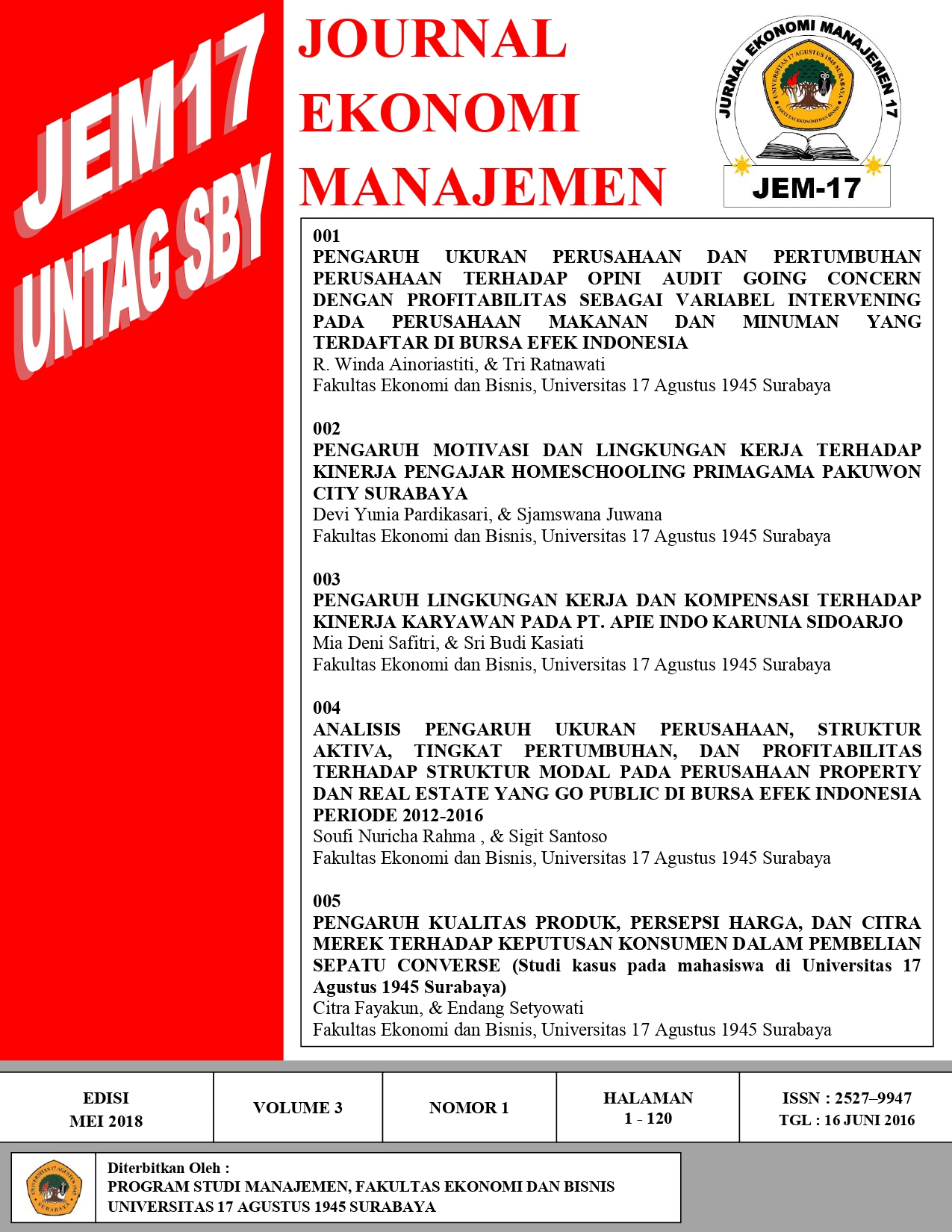
PENGARUH UKURAN PERUSAHAAN DAN PERTUMBUHAN PERUSAHAAN TERHADAP OPINI AUDIT GOING CONCERN DENGAN PROFITABILITAS SEBAGAI VARIABEL INTERVENING PADA PERUSAHAAN MAKANAN DAN MINUMAN YANG TERDAFTAR DI BURSA EFEK INDONESIA
DOI:
https://doi.org/10.30996/jem17.v3i1.3450Abstract
This study aims to find out: (1) Effect of company size on profitability; (2) Effect of company growth on profitability; (3) Effect of company size on going- concern audit opinion; (4) Effect of profitability on going-concern audit opinion; (5) Effect of company growth on going- concern audit opinion. This research uses descriptive quantitative. The population in this study is the food and beverage sector manufacturing companies listed on the Indonesia Stock Exchange in 2015-2017. Data collection techniques using purposive sampling. Samples used in this study were 14 companies from 22 companies registered in 2015-2017. Data analysis techniques use Partial Least Square (PLS). Based on the results of the study show that: (1) The size of the company has a positive and significant effect on profitability. This is indicated by the value of T- statistics of 4.407 (>1.97) and the original sample value of 0.509; (2) Company growth has a negative and not significant effect on profitability with a T-statistic value of 0.698 (<1.97) and an original sample value of 0.0611; (3) The size of the company has a positive and significant effect on the going concern audit opinion with a T-statistic value of 2.484 (> 1.97) and the original sample value of 0.388; (4) The growth of the company has a negative effect and is not significant towards the going concern audit opinion with the value of T-Statistics of 0.437 (<1.97) and the original sample value of -0.0554; (5) Profitability has a negative and significant effect on going-concern audit opinion with a T-statistic value of 3.328 (> 1.96) and an original sample value of -0.576.
Kata Kunci : Going Concern Audit Opinion, Profitability, Company Size, and Company Growth.Downloads
References
[2] Mutchler, J. F. 1984. Auditor Perceptions of the Going-Concern Opinion Decision. Auditing : A Journal of Practice & Theory 3. Spring. pp. 17- 30.
[3] Munawir, S. 2007. Analisa Laporan Keuangan. Edisi 7. Yogyakarta: Liberty
[4] Mulyadi. 2002. Auditing. Edisi keenam. Jakarta: Salemba Empat.
[5] Institut Akuntan Publik Indonesia. 2011. Standar Profesional Akuntan Publik. Jakarta: Salemba Empat.
[6] Brigham, Eugene F. and Joel F. Houston. 2001. Manajemen Keuangan. Edisi 8 Buku 1. (Alih Bahasa: Dodo Suharto dan Hermawan Wibowo). Jakarta: Erlangga.
[7] Yashinta Putri Alichia. 2014. Pengaruh Ukuran Perusahaan, Pertumbuhan Perusahaan, dan Opini Audit Tahun Sebelumnya terhadap Opini Audit Going Concern. Skripsi. Padang: Universitas Negeri Padang.
[8] Setiawan, Santy. 2006. Opini going concern dan Prediksi Kebangkrutan Perusahaan. Jurnal Ilmiah Akuntansi. Vol I No 01. Mei. Hlm. 59-67 Institut Akuntan Publik Indonesia. Standar
[9] Profesional Akuntan Publik (SPAP). Pernyataan Standar Auditing No. 2 dan 21, penggunaan asumsi Kelangsungan usaha yang tidak tepat.Seksi 570. Per 1 Januari 2014, Jakarta: Salemba Empat
[10] Santosa, Arga Fajar, Linda Kusumaning Wedari. 2007. Analisis Faktor-Faktor Yang Mempengaruhi Kecenderungan Penerimaan Opini Audit Going Concern. JAAI Vol. 11 No. 2, Desember 2007: 141158
Downloads
Published
Issue
Section
License
Authors whose manuscript is published will approve the following provisions:
- The right to publication of all journal material published on the JEM17: Jurnal Ekonomi Manajemen website is held by the editorial board with the author's knowledge (moral rights remain the property of the author).
- The formal legal provisions for access to digital articles of this electronic journal are subject to the terms of the Creative Commons Attribution-ShareAlike (CC BY-SA) license, which means JEM17: Jurnal Ekonomi Manajemen reserves the right to store, modify the format, administer in the database, maintain and publish articles without requesting permission from the Author as long as it keeps the Author's name as the owner of Copyright.
- Printed and electronically published manuscripts are open access for educational, research, and library purposes. In addition to these objectives, the editorial board shall not be liable for violations of copyright law.