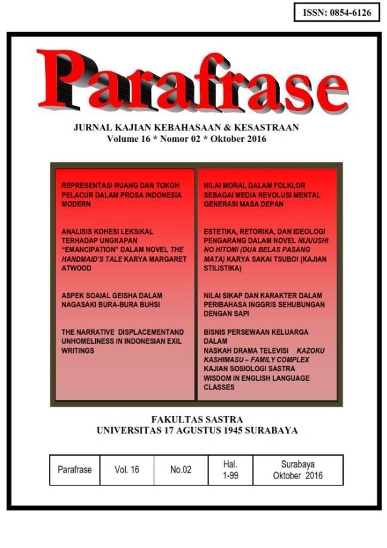
ESTETIKA, RETORIKA, DAN IDEOLOGI PENGARANG DALAM NOVEL NIJUUSHI NO HITOMI (DUA BELAS PASANG MATA) KARYA SAKAI TSUBOI (KAJIAN STILISTIKA)
DOI:
https://doi.org/10.30996/parafrase.v16i02.870Abstract
Sakai Tsuboi was one the Japanese writers who won rewards. One of his works Nijuushi no
Hitomi won a lot of appreciation from its readers. In this novel, Tsuboi showed his ideology of passivism
or the love for peace and anti-war. The language of Nijuushi no Hitomi succeeded in attracting readers’
attention, emotion, and thoughts. There were relationships among the dictions, language style, rethorics,
and these relationships did not reduce the writer’s esthetical sense toward the sociohistorical events.
Keywords : Estetika, Retorika, Ideologi Pengarang, Gaya Bahasa
Downloads
References
Kern, D.Q., "Process Heat Transfer", International
Student Edition, McGraw Hill Kogakusha, Ltd.,
New York.
Holman, J.P., "Heat Transfer", sixth edition,
McGraw Hill, Ltd., New York, 1986.
Mikheyev, M., "Fundamentals of Heat Transfer",
John Willey & Sons Inc., New York, 1986.
Incopera De Witt,Transfer", John Willey & Sons
Inc., New York, 1981.
Ozisik, "Heat Transfer, a basic approach", 1984.
McAdams, W.H., "Heat Transmision", 3rd edition,
McGraw Hill Book Company, Inc., New York.
Karya Sastra. Bandung: Sinar Baru
dan YA3 Malang.
Barthes, Roland. 1973. Mythologies
(Trans. Annette Lavers). London:
Paladin.
Borg, Walter R. 1987. A Practical Guide
for Teachers. New York:
Longman Inc.
Parafrase Vol. 16 No.02 Oktober 2016
Haryono, A (Alih Bahasa). 1989. Dua
Belas Pasang Mata. Jakarta: PT.
Pantja Simpati.
Junus, Umar. 1989. Stilistik: Satu
Pengantar. Kuala Lumpur: Dewan
Bahasa dan Pustaka.
Keraf, Gorys. 1993. Tata Bahasa
Indonesia. Ende: Nusa Indah.
Nurgiyantoro. 2002. Teori Pengkajian
Fiksi. Yogyakarta: Gadjah Mada
Press.
Semi, Atar. 1993. Anatomi Sastra.
Padang: Angkasa Raya.
Downloads
Published
How to Cite
Issue
Section
License
Authors publishing in the Journal will be asked to sign a Copyright Assignment Form. In signing the form, it is assumed that authors have obtained permission to use any copyrighted or previously published material. All authors must read and agree to the conditions outlined in the form, and must sign the form or agree that the corresponding author can sign on their behalf. Articles cannot be published until a signed form has been received.It is a condition of publication that authors assign copyright or license the publication rights in their articles, including abstracts, to email jurnalparafrase@untag-sby.ac.id. . This enables us to ensure full copyright protection and to disseminate the article, and of course the Journal to the widest possible readership in print and electronic formats as appropriate.